Posts tonen met het label arms sales. Alle posts tonen

maandag 14 april 2014

No problem with arms sales to Qatar?


At the closing ceremonies of the DIMDEX Arms Fair Qatar announced arms acquisitions valued at €17 billion ($23 bn.).  This is more than twice the total Dutch annual military budget. Amongst others, the deal includes attack helicopters, guided missiles, tanker planes and naval vessels. Different segments of the orders have a Dutch component. The arms race on the Arabian peninsular has a new player.

On the picture: Patriot PAC-3 being fired.
Qatar is providing political support and weapons to islamists in several internal conflicts in the Middle East, such as in Egypt, Libya, Syria and Yemen. Its support for the Muslim Brotherhood and Al Nusra in Syria has recently created a rift in the Gulf Cooperation Council.

But because of its missile defence capabilities close to Iran, the presence of a US-UK air force base and its rejection of Iran's influence in the region, Qatar is a partner of the West. The arms acquisition plans of the Emirate are part of the military ambitions of the Gulf State to become a stronger player in the Arabian world, on par with its growing soft power influence. Qatar is also the country where Al Jazeera is based.

Amongst others, Qatar wants to buy 22 NH-90 military helicopters from the NH Industries division of European aerospace group Airbus (formerly EADS), worth €2 billion. The Airbus' head offices are located in the Netherlands for tax reasons, but although the Netherlands provides its tax heaven facilities, it has no obligations to control the companies' arms export policies. A win-win situation for Airbus and the Dutch State treasury. Dutch aircraft company Stork Fokker is participating for 5.5% in NH Industries and thus will profit considerably from the Qatar deal.

Another part of the deal is the sale of over €1.5 billion in Patriot missile defence system equipment made by Raytheon and Lockheed Martin. Dutch Fokker Aerostructures “is one of the suppliers for materials of the Lockheed Martin (LMMFC) – PAC-3-program, which is a military program.”

The deal also shows the growing footprint of Dutch shipbuilder Damen in Qatar. At DIMDEX Nakilat Damen Shipyards Qatar signed two Memoranda of Understanding (MoU) with the Qatar Armed Forces to build seven military vessels. “The vessels are highly sophisticated state-of-the-art naval ships based on proven designs providing unparalleled seaworthiness. (...) A large Integrated Logistic Support package is also mentioned in the MoUs” according to the Damen website. NDSQ is a joint venture between Nakilat and Dutch shipbuilder. The Dutch extreme islamophobic political party PVV asked Parliamentary questions on the deal. According to Minister for Trade and Development Ploumen, the deal is in line with Dutch export policies.

All Dutch and international arms control codes, regulations and treaties of the past forty years included regional security, regions of tension and human rights as criteria to measure and refuse arms sales. It seems Qatar is a highly qualified applicant for all three of them. Moreover, because Qatar is notorious for selling its arms to other conflict regions, at least the question has to answered how the end use of the exported equipment will be monitored. According to minister Ploumen:  “When transfers of knowledge take place the Dutch arms export policy offers enough guaranties against undesired effects.” In the case of Qatar, a more concrete and detailed description of these guarantees is no luxury.

Written for Campagne tegen Wapenhandel In Dutch Broekstukken or Sargasso.

dinsdag 9 juli 2013

Troubles in the Desert; Mauritania as arms exports destination

Mauritania can hardly be called a hot spot for international arms traders. Although its military expenditure - almost 4 percent of Gross Domestic Product (GDP) - is a real burden for the desert country, in absolute figures the 116 (2009) million US dollars is less than e.g. the costs of one Dutch offshore patrol vessel. Much of it has to be used for salaries and buildings. Mauritania is the kid on the arms bazaar.


The small military budget is hardly a surprise when you look at the economic situation of the country in general. Mauritania is most of all a vast territory of desert, with two cities on the coast and some smaller villages inland. It is primarily known by its iron ore mines in the east (Zouerate) and its rich fishing grounds, its bird migration area's, its dependence on food donations and its black slave labor.

In Mauritania, about 20% of the population lives on less than US$ 1.25 per day. The Gross Domestic Product (GDP) is € 3.2 billion (about half of the annual Dutch spending on Defence) and results in € 888 per capita. Mauritania is among the poorest countries in the world.

However, the miserable economic situation did not prevent the Mauritanian government to shop at the Paris Air Show, where arms producers exhibit their gear. According to Jane's Defence Weekly (26/06/13), Mauritania signed a contract in Paris with Augusta/Westland, for the purchase of an undisclosed number of so called AW-109 Power helicopters. It was not the first big military acquisition of recent years. In 2009, Mauritania was seen by France as an important country to fight Al-Qaeda in the Islamic Maghreb (AQIM) and so arms transfers began. This French vision was revealed from a secret cable(11/01/2010) by the US embassy in Paris. In the Mauritanian capital Noackchot it was decided to actively cooperate with the Africa Command of the US (AFRICOM). Mauritania was even home country for the most important international special forces exercise, Flintlock, in 2013.

France is by far the most important source of Mauritanian arms. Of the European sales worth € 47 million, (2001-2011) almost sixty percent or € 27 million is sold by Paris. SIPRI mentions huge Chinese sales earlier this century valued € 18.3 million. This included a patrol craft and two 2 French helicopters of the Panther Z-9 type, build by the Chinese firm HarbinAircraft Manufacturing Corporation (Hafei), on a license obtained from Eurocopter. Other major deliverances came from Poland (tanks 2002), Brasil (trainer aircraft, 2012). France also exported five trainer aircraft and tanks (or armoured vehicles) in 2010-2012.

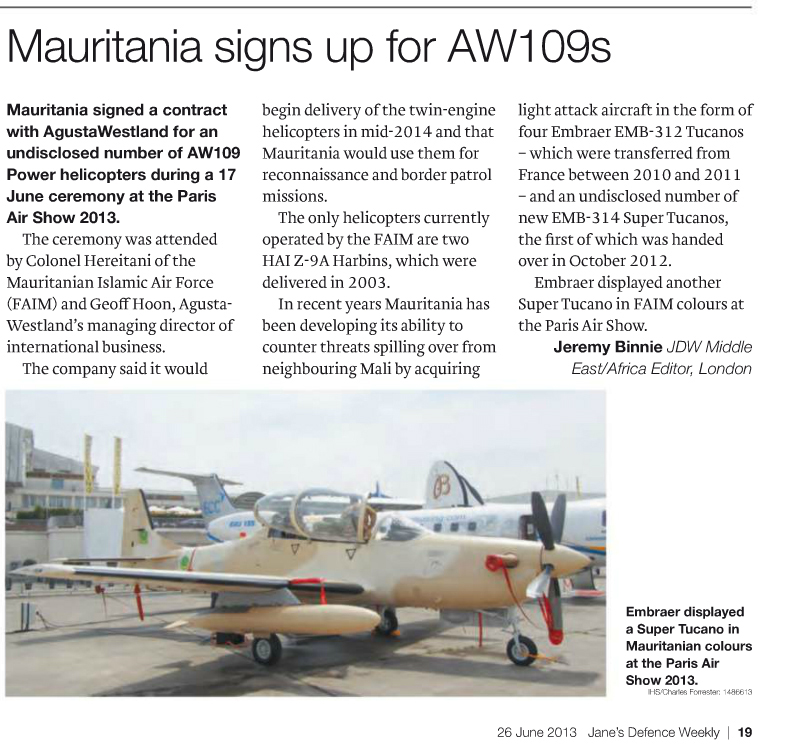
About half of all of the deliveries took place in the last three years. The political situation in the region is the major drive behind it. SIPRI states the five French trainer aircraft are sold because of the struggle against AQIM. Jeremy Binnie, the Weekly's Africa and Middle East correspondent, states: “In recent years Mauritania has been developing its ability to counter threats spilling over from neighbouring Mali by acquiring light attack aircraft in the form of four Embraer EMB- 312 Tucanos - which were transferred from France between 2010 and 2011 – and an undisclosed number of new EMB-314 Super Tucanos, the first of which was handed over in October 2012.”

The sales to Mauritania started because of the contra guerilla operations against AQIM in the Mauritanian desert around 2009, but were beefed up since chaos broke out in neighbouring Mali last year. As such the civil war in Libya, the resulting destruction of the balance of powerin Mali in favour of the Tuaregs, and the reaction on the loose of control by a coup d'etat in Bamako, the Malinese capital, opened a new front for arms deals. The civil war in Libya leaves its traces also in Mauritania. These arms transfers can grow as long as oilfields off the coast in Mauritania are delivering.

Written by with the support Fonds Vredesprojecten