Posts tonen met het label flintlock. Alle posts tonen

vrijdag 21 maart 2014

Military exercises and arms


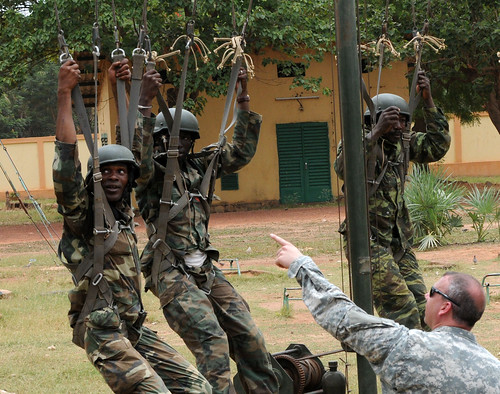
In recent weeks, the U.S. Africa Command annual regional exercise and operation Flintlock took place. Thousand of soldiers from eighteen countries cooperated in this international event for Special Forces. This year the aim of the exercise was to strengthen the position of the participating countries in two North African regions : the southern border region of Libya and the border region of Nigeria. Both are important for arms trafficking and in both areas Islamic terrorists are operating. Of the eighteen participating countries, nine were from West Africa (see map) and nine from Western Europe and North America.

The African participants were Algeria, Burkina Faso, Chad, Mali, Mauritania, Morocco, Niger, Nigeria and Senegal. Several of these countries struggle with internal conflicts. In Mali, Dutch troops will participate in the UN peacekeeping force MINUSMA (United Nations Multidimensional Integrated Stabilization Mission in Mali) to collect intelligence. In Senegal, Special Forces are fighting already for decades against an independence uprising in the southern province Casamance. According to Dutch defence bi-weekly Defensiekrant, the Dutch and the Senegalese troops are special partners during Flintlock. Another participant, Nigeria, which often leads African Union peacekeeping missions, has a military with a domestic problem with human rights, to put it mildly.

Flintlock has implications for the arms market. Military cooperation increases the ability to sell arms. While you exercise, you acquaint with the military leadership and developed contacts that pave the way for commercial contacts. Because of the common struggle against the jihadists, even the poorest countries of North Africa have become arms markets for the West. The purchase by Mauritania, one of the poorest countries in the world, of an undisclosed number of Augusta/Westland helicopters, may serve as an example .

Military cooperation can also follow arms sales. The Netherlands cooperates "with countries for preservation, exports and sales of surplus equipment, e.g. Chile, Estonia, Finland, Jordan, Morocco, Vietnam and South Korea," reported Minister Hennis to the Dutch parliament.

The main buyer of Dutch weapons in North Africa, Morocco is also participating in Flintlock. Morocco takes a fifth position in a ranking of customers for Dutch weapons, with over half a billion euro of military sales to Rabat over the last ten years. Only at position 37 is the second North African country, Algeria. In 2013, this country bought arms valued 34 million euro's.

West Africa is not the only remarkable training area for the Dutch military. According to an overview recently sent to the Parliament by Minister of Defence Hennis, Dutch troops also find partners for exercises, education and training in e.g. Gabon and Peru (jungle training opportunities) and in Jordan and Israel (training facilities for Special Forces).

Martin Broek 10/03/2014
Written for Campagne tegen Wapenhandel
Dutch version of this blog

zondag 9 maart 2014

Oefeningen en wapenhandel

De afgelopen drie weken vond de internationale oefening/operatie voor Special Forces in Afrika, Flintlock, plaats. Duizend militairen uit achttien landen werkten daarbij samen. Doel van de jaarlijkse oefening was dit maal het versterken van de invloed van de deelnemende landen in twee Noordwest Afrikaanse regio's: de zuidgrens van Libië en het grensgebied van Nigeria. Beide zijn belangrijke regio's voor wapensmokkel en gebieden waar islamitische terroristen opereren.

Van die achttien deelnemende landen komen er negen komen uit West-Afrika en negen uit West-Europa en Noord-Amerika.

De Afrikaanse deelnemers zijn Algerije, Burkina Faso, Tsjaad, Mali, Mauretanië, Marokko, Niger, Nigeria en Senegal. Verschillende van deze landen kampen met binnenlandse conflciten. Naar Mali gaan binnenkort Nederlandse troepen om deel te nemen aan de VN-vredesmacht in dat land. Sengalese Special Forces bestrijden in eigen land al decennialang een opstand in de zuidelijke provincie Casamance. De Defensiekrant meldt dat Senegal de samenwerkingspartner is van de Nederlanders tijdens de oefening. Nigeria heeft vaak de leiding bij vredesmissies van de Afrikaanse Unie, maar binnenlands laat het land, om het voorzichtig te zeggen, nogal wat steken vallen.

Als het gaat om wapenhandel dan zijn er internationale criteria waaraan voldaan moet worden. Als het gaat om oefeningen en samenwerking, dan is men minder kieskeurig. Waarom kan je dergelijke landen wel trainen in militaire operaties? De trainingen versterken militaire capaciteiten; ook daar waar die misbruikt worden. Het obligate lesje mensenrechten is daarbij een pleister op de wonde.

De militaire samenwerking vergroot de mogelijkheid om wapens te verkopen. Daar waar je oefent, leer je de militaire leiding kennen en worden contacten gelegd die de weg voor wapenleveranties openen. Door de strijd tegen de jihadisten is zelfs in de armste landen van Noordwest-Afrika een afzetgebied ontstaan. De aankoop door Mauretanië vorig jaar van vliegtuigen lijkt daar een voorbeeld van.

West-Afrika is niet het enige opvallende gebied waar Nederlandse troepen trainen. Minister Hennis stuurde onlangs een brief aan de Kamer waarin ze opsomde waar Nederlandse militairen actief zijn. Partners voor oefening, opleiding en training worden bijvoorbeeld gevonden in Gabon en Peru (jungletrainingsmogelijkheden) en in Jordanië en Israël (trainingsfaciliteiten voor Special Forces).

Militaire samenwerking kan ook wapenverkopen volgen. Nederland werkt militair samen “met landen in verband met instandhouding, verkoop en afstoting van materieel, bijvoorbeeld Chili, Estland, Finland, Jordanië, Marokko, Vietnam en Zuid-Korea,” zo meldde Minister Hennis de Tweede Kamer.

De belangrijkste afnemer van Nederlandse wapens in Noordwest-Afrika, Marokko, doet al mee aan Flintlock. Met ruim een half miljard aan wapenexporten naar Rabat in de afgelopen tien jaar heeft de Nederlandse wapenindustrie het land al binnen als klant. Marokko staat ermee op plaats vijf van een ranglijst met klanten voor Nederlandse wapens. Pas op plaats 37 komt het tweede Noordwest Afrikaanse land Algerije. Daarheen verkocht in 2013 voor 34 miljoen euro militaire goederen.


Deze column is geschreven voor Konfrontatie en is in gewijzigde en engelstalig vorm te vinden op stopwapenhandel

Meer informatie over Flintlock

dinsdag 21 januari 2014

Flintlock 2014


Flintlock is an annual counter operation and exercise organised by Africom in Northwest Africa with Dutch participation. This blog serves as a collection of media reports writing about Flintlock. (The name comes from a firearm-ignition mechanism). GlobalSecurity on the history of Flintlock. and Facebook. See Also: Flintlock 2013 (untill 14 Nov 2013)

Perconferentie Niger voor Flintlock 2014, http://lesahel.org/
***
June 1
***

Will Hartley, Together: Multilateral counter-terrorism exercises, Jane's Intelligence Review, June 2014, pp 14-17.
Multilateral exercises involving Western militaries and those from developing countries in Asia and Africa have increased in the last two decades. Hartley examines how these help respond to ‘new’ security threats, particularly terrorism.

***
16 May
***
Joeva Rock, OP-ED: MilitarisedHumanitarianism in Africa, May 16 2014 (IPS)
(...) Rather than the “shock and awe” of Iraq, the military has attempted to put a friendly face on its expedition to Africa. This past March, writing in the New York Times, Eric Schmitt marveled at AFRICOM’s Operation Flintlock, a multinational and multiagency training operation in Niger.
Schmitt wrote glowingly about fighting terrorism with mosquito nets: “Instead of launching American airstrikes or commando raids on militants,” he wrote, “the latest joint mission between the nations involves something else entirely: American boxes of donated vitamins, prenatal medicines, and mosquito netting to combat malaria.”
Humanitarian and development missions like the ones outlined in Schmitt’s article are at the forefront of AFRICOM’s public relations campaign. But promoting AFRICOM as a humanitarian outfit is misleading at best.
To put it simply, these projects are more like a Trojan Horse: dressed up as gifts, they establish points of entry on the continent when and where they may be needed.(...)

***
19 March
***

(...) Coordination between authorities in Niger and Nigeria, meanwhile, has been hampered by poor communication. With cellphone networks unreliable, officials were forced to communicate by letters that can take three days to get between Niger and Maiduguri, according to a confidential 'early warning report' obtained by Reuters.
The document, compiled by officials from the United Nations and West African bloc ECOWAS who visited Diffa late last year, warned that Boko Haram's presence was "a serious threat that will require increased attention".
Some Western nations seem to agree. It was no coincidence that Diffa was chosen this year to host an annual U.S.-sponsored military exercise, Flintlock - though concerns over security prompted foreign troops to restrict their movements.(...)

David Lewis, INSIGHT-Niger fears contagion from Nigeria's Boko Haram Islamists, Reuters, March 19, 2014

***
14 March
***

With training and partnerships, US military treads lightly in Africa, The Peninsula, March 14, 2014

By David Lewis On a dusty training ground in Niger, US Special Forces teach local troops to deal with suspects who resist arrest. "Speed, aggression, surprise!" an instructor barks as two Nigeriens wrestle a US adviser out of a car.
The drill in the border town of Diffa is part of Exercise Flintlock, a counter-terrorism exercise for nations on the Sahara's southern flanks that the United States organises each year. Washington's aim is to tackle Islamist militants in the Sahel region while keeping its military presence in Africa light.
A growing number of European nations taking part shows their increasing concern about security in West Africa. Central to the international effort is a blossoming relationship between the United States and France, the former colonial power and traditional "policeman" of the turbulent region.
When Paris deployed 4,000 troops to fight Islamist militants in neighbouring Mali last year, the US military lent a hand by airlifting French soldiers and equipment, providing intelligence and training African forces to join the operation.
French troops are stretched by hunting the militants in Mali and tackling religious violence in Central African Republic, so only a handful participated in Flintlock. Nevertheless, they welcomed their new partnership with Washington.
"The Americans want to get involved in Africa. That's good for us. We know that with the Americans it will be more efficient," said a French Special Forces officer, who asked not to be named. "We use American logistics - that's what we are missing. On the other hand, we provide the local knowledge." The United States fast-tracked the sale of 12 Reaper drones to France last year, the first two of which started operating in Niger in January alongside US drones already there.
In a reminder of the partnership, a drone quietly taxied past troops and dignitaries at Flintlock's closing ceremony in the capital of Niamey before taking off to scour the Sahara.
Military experts say direct US military action in Africa is limited to short raids on "high-value" targets in places such as Somalia and Libya, while French troops take on longer, bigger operations.
J Peter Pham, director of the Africa Center at the US-based Atlantic Council, said this arrangement suited US military planners who face budget cuts and a diminished American appetite for combat after conflicts in Iraq and Afghanistan.
However, he warned that the French military was at the limit of its ability to strike militants hard. "If the French are not able to provide that blunt instrument, is the US willing to do so?" Nine years after the Flintlock exercises began, the enemy has evolved from a group of Algerian-dominated fighters focused on northern Mali and now threatens nations across the Sahara and the arid Sahel belt to the south.
For most of 2012, militants occupied northern Mali, a desert zone the size of France. Scattered by a French offensive last year, many are believed to be regrouping in southern Libya.
Hundreds of people are being killed every month in clashes with Boko Haram militants in northern Nigeria. Many in Niger fear this conflict could spill over the border and the government in Niamey has appealed for more military support.
"Instability in neighbouring states has given everybody a new incentive," General James Linder, commander of US Special Operations Command Africa, told Reuters while visiting Niger This year's three-week Flintlock exercise - involving over 1,000 troops from 18 nations - was the biggest yet and runs alongside more permanent training by US Special Forces in Niger, Mauritania, Senegal and Chad.
Training in Diffa, only a few kilometres from where Boko Haram militants are fighting the Nigerian army across the border, ranged from basic patrolling skills and setting up checkpoints to sharing intelligence and providing medical care.
In a region where armies often lack basics such as ammunition for target practice and fuel for vehicles, the quality and tempo of the US-sponsored exercise eclipses the training most soldiers in the region receive in a year.
Colonel Mounkaila Sofiani, the local Niger commander, said Flintlock and other US initiatives helped his country to tackle threats from the west, north and south better. "Little by little people are being trained," he said. "Once there are enough, they'll form the spine of a reliable force." Training is meant to build up coordination between armies but Sofiani said just finding radio equipment compatible between nations is difficult. In the field, officers exchange mobile phone numbers to bypass blockages in official channels.
A lack of trust between governments also hinders responses. At a recent meeting of intelligence chiefs, the Nigerien and Libyan representatives argued over the risk of instability spreading from Libya's lawless south, a diplomat told Reuters.
Coups in Mauritania, Niger and Mali since the Flintlock exercises began also halted cooperation until civilian rule was restored. Mali's 2012 coup, led by a captain with US training, opened the door to the Islamist takeover of the north, prompting questions about what the years of exercises had achieved.
Pham said better military capabilities had not been matched by improvements in governance, citing a failure by Mali to tackle corruption. REUTERS Chad's military, however, has won praise for leading the charge alongside French troops in flushing out the militants from Mali's desolate northern mountains. U.S. officials stress the exercise is African-led and are wary about people reading too much into U.S. troops being on the ground near African conflicts. But the show of foreign support is popular in Diffa. "It sends a message to Boko Haram and others," said Inoussa Saouna, the central government's representative in Diffa. "Before Mali, we thought terrorism was a problem for whites but now we've experienced it ourselves."
***
11 March
***

(...)
"The problems of the Sahel are not restricted to Africa, but concern the whole world," France's defence and national security chief Francis Delon said. Mauritanian analyst Abu Bakr noted, however, that it was difficult for Sahel countries "to cope with security risks individually".
One solution is through enhanced security partnerships, he suggested.
"Because they are sponsored by the armies of the biggest countries in the world," joint military exercises such as Flintlock "enhance the capabilities of Sahel defence forces and support them against any potential terrorist threat", he added.
North Africa; Maghreb Jihadists Killed in Mali Airstrike, Magharebia (Washington DC), March 11, 2014 


AFRICOM GO HOME, Bases étrangères hors d’Afrique est un film document dans le cadre du cinquantenaire des «indépendances» africaines, (OUA 1963 -2013). - See more at: http://www.afrokanlife.com/politique/africom-go-home-un-documentaire-du-professeur-aziz-fall/#sthash.GNusKD90.dpuf
AFRICOM GO HOME, Bases étrangères hors d’Afrique est un film document dans le cadre du cinquantenaire des «indépendances» africaines, (OUA 1963 -2013). - See more at: http://www.afrokanlife.com/politique/africom-go-home-un-documentaire-du-professeur-aziz-fall/#sthash.aaJLS3qK.dpuf

***
6 March
***

(…) The American strategy in Africa also hinges on European partners. In January, France began to reorganize its 3,000 troops in the Sahel region - a vast area on the southern flank of the Sahara that stretches from Senegal to Chad - to carry out counterterrorism operations more effectively, officials said. France will concentrate its air power in Chad, its new reconnaissance drones in Niger, its special operations troops in Burkina Faso and its logistics hub in Ivory Coast.

Against this backdrop, the United States Africa Command is running an annual exercise conducted since 2005 called Flintlock. This year, about 600 African troops and 500 Western trainers and support personnel, including about 300 Americans, participated here and in two cities in central Niger, Agadez and Tahoua.

In temperatures often soaring above 100 degrees, African troops in groups of up to 40 teamed up with advisers from the United States or European allies like Italy, France, Britain and Norway. They practiced marksmanship, patrolling harsh desert terrain and conducting checkpoints against suspicious vehicles.

The daily training has also revealed barriers that extremists could exploit.
Simple communications are often challenging. A Norwegian trainer's explanation of patrolling tactics in English had to be translated into French and then again by another interpreter into Hausa, a language spoken by many of Niger's troops. Any questions started the time-consuming linguistic chain in reverse.

In his office near the exercise, Col. Mounkaila Sofiani, the regional commander of Niger's forces here, who has trained in Morocco and Senegal, and at Fort Benning, Ga., acknowledged the threat from Boko Haram, but insisted his military did not need a permanent American troop presence.
''If our troops are well trained,'' he said, ''we can handle these situations ourselves.''


***
4 March
***


***
3 March
***


By Maj. Will Cambardella
Joint Special Operations Task Force-Trans Sahara Command Public Affairs
AGADEZ, Niger - Canadian Special Operations Regiment shows Sergeant Sawani Anza Adamou, 22nd Battalion, how an inclinometer is used to determine wind speeds during air resupply drop operation in Niger as part of Exercise FLINTLOCK 2014. 

African-led Exercise Flintlock Kicks off in Niger 

AGADEZ, Niger , Mar 3, 2014 — The Niger Army’s 22nd Battalion trained with American, Canadian and Spanish troops supporting Flintlock 2014 on necessary learning objectives for a successful airborne supply delivery here, Feb. 21.

The Niger Armed Forces, otherwise known as the Forces Armées Nigeriennes, or FAN, are receiving instruction via “train-the-trainer” techniques to be able to teach other troops following the three-week exercise. The intent of this training is to enable the Nigerien Forces to resupply themselves, said one Canadian Joint Terminal Attack Controller. “Force projecting allows them to forward-stage in order to interdict AQIM [Al-Qaeda in the Islamic Maghreb] movement.”

Morning training commenced with an overview block of instruction in French on Landing Zone and Drop Zone (DZ) markings, as well as terrain feature recognition. Next, the follow-on instructor disseminated inclinometers to the troops, encouraging the students to demonstrate they understood the equipment well enough to instruct it to others, specifically in orientation and cardinal direction.

The 22nd Battalion’s Sgt. Chef Boubacan Tinga provided DZ formulas during the class, “The drop zone needs to be at least 500 meters in length,” explained Sgt. Chef Tinga. Tinga further illustrated the difference in multiplication tables for paratroopers versus bundles.

The Spanish instructors provided a block of instruction on infiltration/exfiltration techniques to include safety, security, staging and appropriate communication during day and night operations. Special Air Force Operator, 1st Lt. Alfonso provided instruction on using a signal mirror during the day to reflect light and placement of vehicles at night to harness light from headlights. He also emphasized the importance of determining wind speed, strain and direction. 

“Always tell the pilot where the wind is coming from,” said Alfonso. “The more powerful, the more the pilot needs the wind direction—every helo lands facing the wind.”

The troops then proceeded to set up the DZ at the point of impact with red marking panels. Then a C-130 crew air dropped a bundle on flat hard terrain—as instructed.

“This is good training for these guys,” said the Air Liaison Officer, Lt. Col Chris . “They now have a new capability in their toolkit that will help them help themselves in the future.”

The Flintlock exercise is a Chairman of the Joint Chiefs of Staff directed, U.S. Africa Command (AFRICOM) sponsored, Joint Special Operations Task Force-Trans Sahara conducted Special Operations Forces (SOF) exercise, beginning Feb. 19 and going through March 9, throughout several locations in Niger.

***
1 March
***


Militaires marocains et algériens côte à côte au Niger

[Vous devez être inscrit et connecté pour voir cette image]

Fort de ses succès diplomatiques au Mali, le Maroc passe au niveau supérieur. Le royaume cherche à jouer un rôle dans la sécurisation de la région du Sahel. La participation aux manœuvres militaires de « Flintlock 2014 », qui se déroulent au Niger, sous commandement américain, constitue d'ailleurs, un premier pas. Les Algériens y sont également présents.

Le Maroc tient à renforcer sa présence au Sahel. Du 26 février jusqu’au 9 mars, des membres des Forces armées royales (FAR) participent à la 9ème édition des « Flintlock ». Ce sont des exercices militaires, organisées au Niger par l’Africom, qui connaissent la participation d’environ un millier de soldats en provenance de vingt pays africains, européens et américains (Canada et Etats-Unis).

De la diplomatie à l’action militaire

Le royaume prend part à ces manœuvres en sa qualité de membre à part entière alors que durant les opérations qui se sont déroulés en 2013 dans le territoire mauritanien, il avait le titre de pays observateur. Une « promotion » qui atteste, si besoin est, du succès de la nouvelle politique du Maroc dans le Sahel.
Une région est devenue hautement stratégique pour Rabat. La crise malienne a offert aux officiels marocains une réelle opportunité de revenir en Afrique. Depuis, ils n’ont cessé de gagner du terrain. Le « Flintlock 2014 » leur permet donc de passer de la diplomatie et la logistique à l’action militaire.

Marocains et Algériens côte à côte au Niger

L’objectif principal de ces opérations demeure l’amélioration des capacités des militaires dans leur lutte contre les groupes terroristes et le crime organisé, bien établis dans toute la région sahélienne.
Le « Flintlock » de cette année a permis aux militaires marocains de côtoyer leurs homologues algériens sur le même terrain de guerre mais sous commandement américain. Sachant que les deux pays sont en concurrence déclarée pour asseoir leurs influences au Sahel.
Ce n’est d’ailleurs pas la première fois que des militaires des deux Etats voisins participent à des exercices sous commandement américaine ou de l’Alliance atlantique (OTAN). A titre d’exemple, le Maroc et l’Algérie répondent toujours présents aux manœuvres navales « Phoenix express », organisées depuis huit ans par la marine US, dans les eaux de la Méditerranée.

yabiladi

Exercices "Flintlock 2014"Sam 1 Mar 2014 – 15:34, http://far-maroc.forumpro.fr/t3819-exercices-flintlock-2014


***
28 Feb
***

Militairen oefenen in Afrikaans klimaat

Zo’n 45 man Special Forces van het Korps Commandotroepen en het Korps Mariniers zijn in Afrika voor de Amerikaanse oefening Flintlock 2014. De militairen trainen samen met eenheden uit Senegal en Burkina Faso en met Amerikaanse en Europese collega’s. Kennis verkrijgen van en ervaring opdoen met opereren in het Afrikaanse klimaat en terrein staan centraal.

Aan de oefening doen bijna duizend militairen uit veertien landen mee. Met de Afrikaanse partners oefenen de Nederlanders allerlei militaire vaardigheden, zoals patrouilleren, verkennen, navigeren en het inrichten van controleposten. Nederland doet voor de zevende keer mee aan Flintlock. De oefening duurt tot 9 maart.
http://magazines.defensie.nl/defensiekrant/2014/04/kort

***
24 Feb.
***

During the ceremony the Joint Special Operations Task Force – Trans Sahel Commander Col. Kenneth Sipperly, who is the Flintlock 2014 exercise coordinator, said, “Although Flintlock is considered an exercise, it is really an extension of ongoing training, engagement, and operations that help prepare our close Africa partners in the fight against extremism and the enemies that threaten peace, stability, and regional security.”

NIAMEY, Niger, Feb 24, 2014 — Flintlock, the annual African-led military exercise for interoperability in security, counterterrorism and humanitarian aid, officially kicked off today with an opening ceremony celebrating the spirit of cooperation.
The exercise, which beyond U.S. participation includes Burkina Faso, Canada, Chad, France, Germany, Mauritania, the Netherlands, Nigeria, Senegal, United Kingdom, and the host nation of Niger, focuses on building partner capacity to help strengthen stability across Africa. This year, there are 18 different African and Western country participants.
For the next three weeks, more than a 1,000 different soldiers from across these countries will practice military drills such as airdrops of personnel or equipment, live fire ranges, and delivering aid to remote areas with limited medical care.
While not focused on any particular operation or security situation, Flintlock 2014 focuses on the development of the mutual security capacity while strengthening bonds among exercise participants, according to officials.
“Your presence reflects your interests in our regional partnerships,” said Nigerian Col. Mahamane Laminou Sani, the Flintlock country coordinator. “By sharing their experiences, expertise, and camaraderie we share our interests in promoting stability in the region.”
Some of the major tactical components of Flintlock 2014 include small-unit combined training activities against counter-terrorism, along with humanitarian relief operations providing basic medical, dental, and veterinary access for select communities in Niger.
The host nation led the development of the exercises’ training objectives to help build relationships between participating nations.
U.S. leadership attended the ceremony along with their counterparts and they said they agree that security is necessary for growth and stability. Special Operations Command Africa Commanding General Brig. Gen. James Linder joined African nation partners for opening ceremony activities.
During the ceremony the Joint Special Operations Task Force – Trans Sahel Commander Col. Kenneth Sipperly, who is the Flintlock 2014 exercise coordinator, said, “Although Flintlock is considered an exercise, it is really an extension of ongoing training, engagement, and operations that help prepare our close Africa partners in the fight against extremism and the enemies that threaten peace, stability, and regional security.”
“Working together to guard against the effects of extremism will be realized by the future generations of all our countries,” he said.
The Nigerian Chief of Staff M. Karidio Mahamadou agreed, adding that, “This exercise is occurring at a time when our nations are faced with multiple obstacles within our region which requires strong resolve to confront extremism.”
Flintlock exercises have been conducted across north and western Africa since 2005 to improve the security capacity of regional military forces.

Follow and share your comments on Facebook and Twitter at #Flintlock2014
Scott Nielsen, African-led Exercise Flintlock Kicks off in Niger, U.S. AFRICOM Public Affairs February 24, 2014.

***
23 Feb.
***

Up to 1,000 soldiers and army officials from 18 African countries began a joint military training exercise in Niger against terrorism in the Sahel region.
The joint military exercise dubbed "Flintlock" is being conducted in Niger's Agadez, Diffa and Tahoua regions between Feb. 20 and March 9.
The "Flintlock" exercise was initiated in 2005 with the objective of developing capacities of defense and security forces and promoting inter-state collaborations to protect the people of Sahel countries.
At the opening of the training session, Nigerien army chief Seini Garba hailed the holding of the Flintlock training to promote security in the Sahel region, a belt along the southern edge of the Sahara desert being made a haven for terrorism and cross-border crimes.
Gen. Garba said Nigerien President Mahamadou Issoufou had reaffirmed his support for the program to promote strategic partnerships and information sharing among the different armies.
The "Flintlock 2014" training program is being coordinated by the U.S. military and Nigerien Col. Lamine Mahamane.
The military training began just after the third council meeting of foreign ministers held in Niamey to discuss cooperation in war against terrorism and an African Peace and Security Architecture in the Sahel-Saharan region.
18 Nations In Joint Anti-Terrorism Exercise, Forum on China-Africa Cooperation (Beijing), February 23, 2014

***
20 Feb.
***

The war game reflects the Pentagon’s increasing preference for light, secretive Special Operations Forces in the ongoing international campaign against terrorists and other “irregular” threats.
Joe Trevithick, America Is in Niger to Help Train Commandos From 18 Countries
Flintlock exercise is evidence of growing Special Ops war in Africa, War is Boring, February 20, 2014.

--

Foreign ministers from the Sahel and West Africa met in Niamey on Wednesday (February 19th) to hammer out a response to terrorism and organised crime across the region.
The gathering included top diplomats from Algeria, Mauritania, Libya and others in the Fusion and Liaison Unit (UFL), who met with their counterparts from Senegal, Guinea and Cote d'Ivoire.
The ministers discussed the political and security situation in the Sahel-Sahara region, closer security co-operation and the implementation of the African Peace and Security architecture. They were joined by intelligence and security chiefs from their respective countries and representatives of the African Union and ECOWAS.
"The recent events in Gao in Mali involving the kidnapping of an ICRC team, for which MUJAO has claimed responsibility, clearly show how fragile the security situation in our region is and illustrate the urgent need for closer co-operation between the relevant actors," Nigerien Foreign Minister Mohamed Bazoum said in his opening speech.
Bazoum added: "Niger is suffering the collateral fallout of the Libyan and Malian crises, and at a very early stage it began seeking ways of safeguarding its extra-community borders through a partnership guaranteeing human rights and the free movement of people."
In his view, "the political and security situation in Libya is still characterised by rather worrying tensions. We must think about it so that we can help to start a new trend."
During a speech about the counter-terrorism strategy devised by his institution, ECOWAS Commission Chairman Kadré Désiré Ouedraogo underlined that: "This strategy is based on three main pillars, namely prevention, suppression and rebuilding."
"There is no doubt that if they are well co-ordinated, the strategies initiated by various organisations should make a significant contribution to socio-economic development and stability in the Sahel region, in accordance with the principles of democracy, good governance and the rule of law, so as to prevent new crises in the future," he said.
For his part, Algerian Foreign Minister Ramtane Lamamra highlighted the close co-ordination between his country and Niger.
"We also know the determination of Niger, which is shared with Algeria, with regard to everything that concerns the battle against terrorism and organised cross-border crime," Lamamra told the press on the side-lines of this third ministerial meeting of the member states of the African Union's "Nouakchott Process" to build Sahel stability.
He also said that the contributions made by Algeria and Mauritania "consisted of making their own borders secure and ensuring that terrorist and criminal groups have nowhere to retreat to within the two countries".
"In the face of the threat on our borders, the Nouakchott Process must maintain a more sustained pace and innovate continually to adapt to the changes on the ground," said Smail Chergui, the African Union's commissioner for peace and security.
Chergui added: "Building intelligence and security capabilities in the Sahel-Sahara region is more than necessary to deal with the terrorist threat. This means that the strategies identified must be strengthened to tackle this scourge." 
Niger Hosts Sahel Security Summit, Magharebia (Washington DC), February 20, 2014

***
19 Feb.
***

Zo’n 45 militairen van het Korps Commandotroepen en de special forces (NLMARSOF) van het Korps Mariniers zijn in Afrika voor de Amerikaanse oefening Flintlock 2014. De militairen trainen samen met Afrikaanse eenheden uit Senegal en Burkina Faso en met Amerikaanse en Europese collega’s. Het opdoen van kennis van en ervaring met het optreden in het Afrikaanse klimaat en terrein staan centraal.     
Aan de oefening doen bijna 1000 militairen uit zo’n 14 verschillende landen mee. Met de Afrikaanse partners wordt geoefend in militaire vaardigheden zoals patrouilleren, verkennen, navigeren en het inrichten van controleposten. Nederland doet voor de zevende keer mee aan Flintlock.
De luchtmacht zet een Hercules C-130 transportvliegtuig in voor de logistieke ondersteuning van de oefening. De oefening Flintlock duurt tot 9 maart.
Militairen oefenen in Afrikaans klimaat, Nieuwsbericht, 19 februari 2014

***
6 Feb.
***

Mi-février, un nouveau détachement de forces spéciales américaines et françaises est attendu au Niger. Officiellement pour participer à l'exercice Flint Lock 2014. Exercice régional qui s'est déjà déroulé par le passé au Mali et en Mauritanie.

***
22 Jan.
***

No new information

***
20 Jan.
***

L’édition de cette année [de Flintlock] intervient dans un contexte marqué par l’escalade de la violence en Libye, où des groupes extrémistes liés à Al-Qaïda, tels que ceux d’Ansar al-Sharia, se sont implantés dans plusieurs villes de l’est. La zone est d’ailleurs régulièrement survolée par des drones dont la mission se charge de la collecte d’informations.
Sahel : Démarrage en février des exercices « Flintlock, 20 janvier 2014 par Samuel Benshimon, Sahel Intelligence.

***
17 Jan.
***

Military service members from African, European and North American countries will gather in Niger next month for the "Flintlock" exercise.
The two-week drill, which focuses on Africa's fight against terrorism and trafficking, includes air and land operations.
Held every year n nations across the Sahel region, the exercises are planned by US Special Operations to develop the capacity and collaboration among African security forces to protect civilian populations.
Jemal Oumar in Nouakchott, Sahel military forces train together, Magharebia – 17/01/2014

***
3 Jan.
***


Similarly aspects of Operation Enduring Freedom Trans-Sahara (OEFTS) such as the Flintlock system have worked to shore up essential communication and infrastructure within 25 countries. Given that AFRICOM was first proposed as an idea in 2000, this is a remarkable degree of growth and cooperation that reflects the growing level of importance with which Africa now factors into US policymakers’ decisions.
Sean Durns, Growing US securitypresence in Africa allows safer investments, http://globalriskinsights.com/, January 3, 2014


Previous Flintlock blogs on Broekstukken:
military-exercises-and-arms (21 mar 2014)

Flintlock in the press 2013
The Dutch and the War on Terror … in Africa  (11 Feb 2011)
Nederlanders in War on Terror….in Afrika (03 Feb 2011)

Previous Mali blogs on Broekstukken:
Mali in de pers (Jan, Feb, Mar, Apr 2014)
Wapenleveranties aan Libië en de buurlanden (07 Sep 2012)

donderdag 14 november 2013

Flintlock 2013


wheellock mechanism, predecessor of flintlock
Flintlock is an annual contraterrorism operation and exercise  in Northwest Africa with Dutch participation. This blog serves as a collection of media reports writing about Flintlock. (The name comes from a firearm-ignition mechanism). GlobalSecurity on the history of Flintlock.

***
Special Operations Forces Field Training Exercises in Africa, November 6, 2013
http://codebookafrica.files.wordpress.com/2013/11/120918_africom-jetp-budget-fy14.jpg

***

African Journalists Interview Top U.S. Officials
m October 24, 2013 

(...) 
MS. JENSEN: Great. Niger is on the forefront of counterterrorism primarily because of its strategic location. In February, Niger will host Flintlock 2014. How we can we ensure that this exercise is a success and supports the role of Nigerians leading the effort? 

GENERAL RODRIGUEZ: Well, as you said, the Nigerians are at a strategic location and are part of the partnership and the solution to the challenges of what is happening in Libya and the movement of the arms, ammunition, explosives, and personnel across Northwest Africa. So we are working with our partner nation, and the best thing that we can do, I think, is during the Flintlock exercise or anything else is help them where they need it most. So we are listening to the leaders to ensure that what we help provide them, and the exercise and the training we provide them, is what they most need to help support their security on that northern region.

(...)

 
Africom Go Home!
, June 6, 2013, Pambazuka

The African continent has been thoroughly decimated by over three decades of structural adjustment, which has downsized the state and resulted in technocrats running our governments. It has also created a fictitious sense of democracy, which has depoliticized our populations and left our countries victims of a particularly vicious virus of dependency. In military terms, Africa remains fragmented and vulnerable in the face of fundamental challenges, such as the foreign occupation of the Congo, the Ivory Coast, Libya and Mali. At the same time, the possibility of playing the instability card looms menacingly over the Sudan, Egypt, Nigeria, Tunisia and the Central African Republic as well as Algeria.

Here the UN is instrumentalized, paving the way for the intervention of NATO forces. The apparent unity of militarized African countries in these peacekeeping missions is a reflection of imperialism. For example, thirty-six countries on the continent sent their 'next generation of leaders in the security sector' (ACSS) to receive training in Washington DC. Those high-ranking officers who did so were included under the umbrella of operational and military capacity building within AFRICOM's Theater Security Cooperation Programs (TSCP). The Africa Contingency Operations Training and Assistance (ACOTA) program rounds out these infantry training projects and has made inroads into the delivery of multilateral training to UN peacekeepers. Over the last decade, a growing number of African armies have participated in the annual FLINTLOCK antiterrorist maneuvers held in North and West Africa. Then there is the AFRICA ENDEAVOR, which bills itself as an opportunity to develop skills in the area of intelligence communication. CUTLASS EXPRESS refers to a series of maritime strategies designed to control the flow of all traffic around East Africa and the Indian Ocean.


*****

What Mali Says About U.S. Strategy, January 17, 2013 NYT

The U.S. has conducted a counterterrorism and security forces training regimen through the Pan Sahel Initiative, the Trans-Sahara Counterterrorism Partnership and Operation Flintlock with Mali for the past 10 years and despite that effort, intelligence and special forces officials were taken by surprise in July 2012 when officers it had trained unseated a democratically elected president.

http://www.nytimes.com/roomfordebate/2013/01/15/is-mali-a-new-line-in-the-sand-against-terror/what-mali-says-about-us-and-international-strategy-in-the-region 

***


zondag 16 december 2012

Chaos in Mali; collateral damage van de oorlog in Libië

Al Qaeda heerst in Noord-Mali, in een gebied zo groot als als Frankrijk. Dat deel van Mali wordt ook Azawad genoemd. De lokale bevolking wordt er nu onderdrukt, traditionele muziek is verboden en werelderfgoed werd vernield. Er is een uitvalsbasis voor islamistische terreur gecreëerd.

Photo: US Special Forces in Mali (bron Atlantic Council U.S.: acus.org/us-special-forces-mali

Het begon begin dit jaar als slot van de oorlog in Libië. Toearegs, de lokale nomaden, bekend van hun indigoblauwe gewaden, kwamen terug naar Mali. In Libië als militairen in dienst van Khadaffi Hun wapens brachten ze mee terug (eerder schreef ik hierover) Hierdoor veranderde het machtsevenwicht in Noord-Mali in het voordeel van de nomaden ten koste van de regering in Bamako, de hoofdstad van Mali. De Toearegs leven al decennia in onmin met die overheid. De regio kende opstand na opstand. Door de meegenomen wapens konden ze hun eisen voor onafhankelijkheid kracht bij zetten.

Twee partijen reageerden op de veranderde situatie: Islamisten van Ansar al-Din, die banden onderhouden met Al Qa'ida, en de legereenheden uit Bamako. Hoewel de eisen van de Toearegs in de hoofdstad Bamako nooit serieus werden genomen, was het leger ook nooit sterk genoeg om de zelfbeschikkingsaspiraties voorgoed de kop in te drukken. Met hulp van de islamisten konden de in het Libische leger bewapende Toearegs de centrale overheid de baas en de Nationale Beweging voor de Bevrijding van Azawad (MNLA) riep een onafhankelijke staat uit. Helaas voor de Toearegs; ze haalden zo hun eigen vijand binnen. De islamisten namen uiteindelijk de touwtjes in handen en brachten het grootste deel van het gebied onder hun controle. Ze vestigden er hun zeer rigide salafistische islam. Inmiddels zijn er vijf verschillende groepen (zie link). Ze worden voor een deel gedreven door fanatiek geloof. En voor een deel door op macht en rijkdom beluste leiders.(zie link) Zowel vertegenwoordigers van MNLA als van Ansar al-Din zoeken momenteel aan de onderhandelingstafel al naar mogelijke uitwegen uit de crisis. Als dat lukt, zullen de enkele honderden Al Qaeda strijders nauwelijks een probleem vormen.

Aan de andere kant reageerden Malinese legereenheden. Zij vonden dat ze te weinig wapens en middelen hadden om de strijd aan te gaan. Amadou Toumani Touré, de president werd afgezet door troepen onder leiding van kaptein Sanogo. Militairen namen de macht in handen. De chaos die daardoor ontstond was vooral in het voordeel van de strijders in het noorden. De coup werd veroordeeld door de internationale gemeenschap. De president nam zijn zetel al snel weer in om daarna ordentelijk af te kunnen treden. Mali kreeg daarna weer een nieuwe president. Maar in december 2012 werd de premier door Sanogo uit zijn zetel gezet en al snel vervangen door een nieuwe premier. De crisis in Mali werd er door verergerd. Militairen hebben achter de schermen de touwtjes in handen, zo werd onderstreept.

Interessant en niet onbelangrijk is dat Sanogo in de VS is opgeleid. Nog belangrijker is dat troepen van Mali al jaren worden opgeleid door Westerse elite eenheden. Special Forces uit de Verenigde Staten zijn permanent in het land aanwezig. Begin dit jaar deden Nederlandse commando's en mariniers nog mee met de jaarlijkse oefening Flintlock. Het Nederlandse contigent groeide jaar in jaar uit. De oefening cq. operatie zou een paar maanden moeten duren en heel West-Afrika moeten bestrijken. Ze werd vanuit Mali gecoördineerd. Deze militaire betrokkenheid is er op gericht het islamisme klein te houden in West-Afrika. Het Malinese leger krijgt daarvoor een kleine tweehonderd miljoen dollar per jaar van de Amerikanen. Op een Bruto Nationaal Product van maar negen miljard geen kleinigheid. Ondanks die steun liep het onder de ogen van de militairen mis in Mali. Het gevolg van de coup was chaos, onrust en een enorme hoeveelheid vluchtelingen. De Nederlandse troepen waren al naar huis geroepen. Amerikaanse troepen (waaronder een eenheid SEALS, SeaAirLand forces) waren nog in het land nadat de coup plaatsvond.

Op dit moment staat een vredesmissie van de Afrikaanse Unie en/of ECOWAS op stapel: AFISMA (African-led International Support Mission). Het zou moeten gaan om ruim 3000 militairen, gesteund met Europese adviezen en Amerikaanse en Franse inlichtingen voor het enorme gebied. De operatie zal zo'n half miljard kosten. De Amerikaanse minister van Defensie Leon Panetta heeft beloofd achter Al Qa'ida aan te gaan “wherever the hell they're at, and make sure they find no place to hide.” En ja, als het nodig is vallen de Amerikanen gewapenderhand Mali binnen. Dat de VN waarschuwde dat een militaire aanpak mogelijk tot een half miljoen vluchtelingen zal kunnen leiden is van later zorg. Mogelijk zijn Panetta's woorden bedoeld om druk op de verschillende partijen uit te oefenen om aan de onderhandelingstafel tot een oplossing te komen. Want zoals zo vaak ligt daar de oplossing. Een militaire aanpak leidt vaak tot nieuwe problemen. Die vervolgens dan weer militair kunnen worden “opgelost”.

Onderzoek ondersteund door Fonds Vredesprojecten

dinsdag 3 april 2012


Militaire operaties: hou ze klein en onzichtbaar

Een beperkte militaire inzet die te klein is om de aandacht in de media te trekken, kan meer succes hebben dan een grootschalige militaire operatie die permanent het onderwerp is van politieke profilering.”

Dit is de conclusie van een essay uit de Militaire Spectator, vakblad voor militair kader, van december 2011. Het heeft een opmerkelijke ondertitel: “De relaties tussen het aantal in te zetten militairen, democratische besluitvorming en de media” en is geschreven door lt. Kolonel Claessen. Claessen is een Belgische militair werkzaam op de afdeling Strategie van de Belgische Defensiestaf.

Het is vrijwel onvermijdelijk dat Irak, maar ook de Vietnamoorlog in een dergelijk artikel van stal wordt gehaald: “Om een dergelijk gedwongen terugtocht te vermijden moeten democratische regeringen daarom een strategie hebben die hen beschermt tegen de effecten van politieke en maatschappelijke verdeeldheid op het verloop van een conflict.” De bevolking zal doorgaans de hoge kosten die gepaard gaan met een langdurig conflict niet blijvend steunen. Dat blijkt in beide gevallen. Regeringen kunnen dan niet de democratie opzijzetten of alle energie gebruiken voor het doordrukken van een blijvende interventie. Er zijn dan eigenlijk maar twee opties over: een beslissend gevecht organiseren of low profile operaties.

De term Low profile operaties is oude wijn in nieuwe zakken. In de jaren tachtig werden dergelijke operaties geschaard onder de term Low Intensity Conflict (LIC). LIC is bekend geworden door operaties in Nicaragua, El Salvador en op de Filipijnen tegen het linkse verzet. De kleinschalige inzet in El Salvador toonde volgens Claessen het succes van een dergelijke benadering aan: “De 55 Amerikaanse militairen in het land boden geen enkele bescherming tegen de rebellen. De junta had ook geen andere keuze dan in te gaan op de Amerikaanse eisen.” Ze zouden anders geen munitie en wapens meer krijgen en verliezen van het verzet. De huidige kleinschalige militaire operaties in Colombia en de inzet in de Filipijnen in het kader van Operation Enduring Freedom (OEF) worden door Claessen als positief vervolg op El Salvador genoemd. Het gaat bij die operaties om kleinschalige inzet van nog geen honderd specialistische militairen. Training, opleiding en advies  moeten leiden tot een leger dat afhankelijk is van steun en daarom medewerking zal verlenen aan de politieke doelstelling van het interveniërende land, zoals in El Salvador gebeurde.

---

Dit jaar deden Nederlandse special forces mee aan de operatie cq. oefening Flintlock in Noordwest Afrika. Flintlock is onderdeel van de Amerikaanse OEF-operatie. De Nederlandse deelname aan deze oefening werd blootgelegd door vijf studenten die deelnamen aan een cursus onderzoeksjournalistiek. Hun onderzoek leidde tot Kamervragen, diverse media putten uit hun onderzoek voor verdere publicatie. Het onderzoekswerk van de studenten weerspreekt de stelling uit de Militaire Spectator: ook kleine operaties kunnen onderzocht worden en een militaire actie 'politiek profileren'.

---

In het maartnummer van de Militaire Spectator staat: “(…), de besluitvormingsprocedure voor speciale operaties en de grote mate van geheimhouding biedt de regering een relatief eenvoudige mogelijkheid tot inzet van een grote missie met een robuust mandaat.” Dat schrijven Martijn van der Vorm (auteur van een boek over de commando's) met twee militairen die aan commando operaties in Afghanistan deelnamen. De informatie over inzet van commando's of special forces wordt in een besloten bijeenkomst aan de fractievoorzitters gegeven, vergelijkbaar met de Commissie Stiekem (de commissie die gaat over inlichtingendiensten). Dat kan ook pas achteraf zijn. Zo wordt de Tweede Kamer gedeeltelijk buitenspel gezet bij controle op Nederlands militair optreden. Dit beleid is vastgesteld door toenmalig minister van Defensie Frank de Grave, in een brief uit 2000. Ook in deze procedure weer die geheimzinnigheid en gebrekkige controle.

Ik word niet vrolijk van dergelijke creatieve oplossingen buiten de democratie om. Vooral omdat ze ook nog blijken te werken ook. Er is relatief weinig politieke en publieke aandacht voor de operaties van de commando's in Afghanistan, stellen schrijvers Van der Vorm et al. Maar anders dan deze schrijvers meen ik dat dit een slechte zaak is. Het militair apparaat is de gewapende tak van de Staat. Die Staat moet worden gecontroleerd door het Parlement en dat moet daarbij zoveel mogelijk geïnformeerd worden. Niet beperkt. Ook niet als het net even iets moeilijker ligt. Een Staat bestieren is geen spelletje voor het kabinet, sceptische parlementariërs en onderzoeksjournalisten, maar een serieuze kwestie voor volwassen mensen. Klinkt dit naïef? Dat zal wel. Maar als je gewoon in het openbaar je strategieën om buiten de spotlights te blijven kan opschrijven, mag ik dan een klein beetje argeloos zijn?

Low profile operaties zijn “gebaseerd op het feit dat een militaire deelname aan een conflict onbeperkt kan worden volgehouden indien de pers en het electoraat er geen interesse in hebben,” schrijft Claessen. Sceptische journalisten en onderzoekende parlementariërs zijn gewaarschuwd: je kan lezen hoe je bedonderd wordt. Militairen kunnen zo brutaal worden bij de gratie van dat niemand ze een voet dwars zet. Speciale troepen worden belangrijker in de Nederlandse krijgsmacht; ze vallen zelfs buiten de bezuinigingen. Misschien tijd om te kijken of ze ook meer in het openbaar gecontroleerd kunnen worden en niet een excuus vormen voor een gemakkelijk ontsnappingsroute weg van de parlementaire controle bij militaire inzet.

Martin Broek

Geschreven voor Konfrontatie

dinsdag 26 april 2011

Flintlock Kamervragen


Het komt niet elke dag voor dat mijn blog in Kamervragen genoemd wordt.


Vragen van de leden Van Bommel, Van Dijk en Irrgang (allen SP) aan de ministers van Defensie en Buitenlandse Zaken over inzet Nederlandse militairen in Sahel-landen.

1. Is het juist dat de Flintlock-operatie in het kader van terrorismebestrijding wordt uitgevoerd en deel uitmaakt van de Operatie Enduring Freedom Trans Sahara? Indien neen, hoe zijn dan de feiten? (1)

2. Is het juist dat Nederland vanaf 2005 betrokken is bij de operatie Flintlock? (2) Indien neen, hoe zijn dan de feiten? Kunt u een overzicht geven van de Flintlock-operaties van de afgelopen jaren waaraan Nederland heeft deelgenomen; hoeveel Nederlandse militairen deelnamen en wat de doelen waren van de afzonderlijke operaties? Zijn de doelen gehaald? Welke taken hadden de Nederlands militairen?

3. Is het juist dat de operatie is opgezet in het kader van de Amerikaanse Special Forces Commando voor Afrika (JSOFT-S)? Is het juist dat het om een multinationale militaire activiteit gaat waarbij Nederland deelneemt aan een Multinationaal Coördinatiecentrum? Indien neen, hoe zijn dan de feiten?

4. Is het juist dat vuurgevechten niet zijn uit te sluiten tijdens Flintlock? Hoeveel tic’s (troops in contact) heeft Nederland gehad vanaf 2005 tijdens Flintlock? Deelt u de opvatting dat oefeningen waarbij vuurgevechten niet zijn uit te sluiten ook aan het parlement moeten worden gemeld? Indien neen, kunt u aangeven waarom? (3) Zo ja, op welke wijze gaat u dat vormgeven?

5 Is het tevens juist dat tijdens deze oefening ook militairen van diverse Afrikaanse landen zijn opgeleid? Zo ja, om welke landen ging het precies en wat voor soort functies werden deze militairen opgeleid?

6. Welke landen nemen aan deze operaties deel? Is het juist dat niet ieder deelnemend land aan deze operatie bekend wil maken dat het meedoet? Wat is de reden van deze geheimhouding? (4)

6. Waarom is Nederlandse deelname niet aan de Kamer meegedeeld en is evenmin gewerkt in het kader van een artikel 100-procedure? (5) Is deelname van Nederlandse militairen door de Militaire Kerngroep Speciale Operaties (MKSO) beslist? Zo ja, wanneer? Indien neen, door welke minister is tot deze operatie beslist?

7. Welke politieke prioriteit geeft u aan het opleiden van Afrikaanse militairen, special forces? Wanneer en op welke wijze is deze beleidslijn aan de Kamer voorgelegd?

8. Deelt u de opvatting dat deze operatie de militarisering van politieke problemen in de Sahel-landen in de hand werkt? Deelt u tevens de mening de aanwezigheid van Nederlandse en andere Westerse troepen verdere weerstand op kan wekken? Indien neen, waarom niet?

Bronnen:
1 “Nederlanders in War on Terror… in Afrika”. Martin Broek, februari 2011, zie http://broekstukken.blogspot.com/2011/02/nederlanders-in-war-on-terrorin-afrika.html.
2. Algemeen Dagblad, 23 april 2011, “Geheime missie, Nederlandse militairen trainen Afrikanen in Sahel”.
3. AD, 23 april 2011; “Defensiespecialist Colijn: “Maar je zou kunnen zeggen dat oefeningen waarbij vuurgevechten niet zijn uit te sluiten, ook moeten worden gemeld.”
4. Zie voor oefening in 2011, Flintlock 11 Kicks Off February 21 in Senegal, zie http://www.africom.mil/getArticle.asp?art=5937.
5. Zie voor informatie over Sahel-politiek met name 32500 V nr 8, d.d. 20 oktober 2010. Zie antwoorden op vragen 133 en 135 waarin direct wordt gevraagd naar wijzen van terreurbestrijding in Sahel-landen. In het antwoord wordt alleen Mali genoemd. Zie ook Verslag RBZ van 25 oktober 2010, 21501-02 nr 995, d.d. 26 oktber 2010. Zie tevens Verslag schriftelijk overleg inzake geannoteerde agenda RBZ 31 januari 2011. 21501-2 nr 1020 d.d. 28 januari 2011.

vrijdag 11 februari 2011

The Dutch and the War on Terror … in Africa

The Netherlands does not only send police trainers to Afghanistan, but also military trainers to Africa, defence periodical Jane’s Defence Weekly reports. The mission covers a territory larger than Western Europe. It is part of an exercise and operation that takes place in Algeria, Chad and Senegal, to name a few. The training will focus on fighting illegal arms trade, smuggling and human trafficking, according to Jane’s. So many positive goals in one sentence calls for some skepticism. Especially when we realize what kind of troops involved.


The exercise is named Flintlock. Flintlock is also the term for an igniter for small arms. Not really a name for an operation tackling illegal arms trade. And so that's not really what it is. Flintlock is a permanent activity in the framework of the American war against the terrorism (Operation Enduring Freedom, OEF). It is organized around the Special Forces, the US troops best equipped and trained for heavy fighting in small and independent groups and for almost surgical individual operations for collecting information, or killing individuals.

Flintlock is an exercise operation established and coordinated through the US Joint Special Operations Task Force - Trans-Sahara (JSOTF-TS). It is not solely focused on training, but it is a multinational military activity of which training allies is an aspect. Already in 2005, 700 American Special Forces trained 2,100 badly armed soldiers from North and West-African countries, under the name Flintlock. The Netherlands is involved since that time.

Connected to Flintlock, a permanent Multinational Co-ordination Center (MCC) created to streamline the counter-terrorism activities in Mali, Mauritania, Senegal and Chad. When asked, the Dutch ministry of Defence affirmed a few dozen Dutch marines and commando troopers are in Senegal, Chad and Burkina Faso from mid January until half March 2011. They will practice Special Forces operations with forces from those three countries and a number of other European and African countries. Which other countries will participate the ministry of Defence does not want to tell: "Not all countries want to make that public."

Last year the Dutch weekly military paper, the Defensiekrant, interviewed four Dutch soldiers that took part in Flintlock: Emiel of the army, Rob of the marines and the commandos Eric and Tom. They all said they were eager to return. Rob on Senegal: "You can hike sixty kilometers from the coast into the country, straight through the mangroves. Fantastic!" The largest mangrove area of Senegal lies in the Casamance. In this southern part of Senegal a small armed independency movement is active. In December last year seven Senegalese soldiers died during a clash, Radio France Internationale reported. The training provided will thus be welcomed by the Senegalese. For arms trade EU criteria exist to measure the effect of trade on human rights, security and development. How about comparable rules for providing training in regions of tension or with high risk of human rights violations? A question which should be asked in parliament.

A high ranked Dutch military, Major General Tom Middendorp, last year watched the operations and came also back enthusiastically. "The particulars of this formula is that you not only train African troops, but also conduct cross training with the participating countries under heavy circumstances. Many goals in one go. Formerly we sent observers only, now we joined with some troops. To me this seems something to repeat," the Defensiekrant quoted the general. Half a year later this is exactly what happens.

For the United States Flintlock is an operation in the framework of the fight against terrorism. US officer John Williamson, responsible for organizing Flintlock, is glad with the Dutch contribution. He says in a press explanation of JSOTF: "(…) the increased participation of our European SOF partners such as Germany, the Netherlands, and Spain in tactical training and MCC activities, underscores the importance of our desire for an international approach toward trans-border terrorist threats."

The Netherlands is regarding Flintlock as an exercise during which Special Forces train others and themselves, according to the Dutch ministry of Defence. It is not seen as an operation. This is despite the fact the US regards it as such and although there is a permanent command structure. But the semantics around the participation clearly shows the Netherlands are involved in the War on Terror or Operation Enduring Freedom on more than one front. Not only in Afghanistan, as is easily forgotten because of all attention for the new deployment in Kunduz.

Martin Broek

(edited by Frank van Schaik)

Sources:
* Zapatero ofrece a EE UU aumentar su presencia militar en España [Zapatero offered to increase U.S. military presence in Spain], Ignacio Cembrero, El Pais, Madrid December 7, 2010.
* Training in Trans-Sahara Africa, Max R. Blumenfeld, JSOTF-TS Public Affairs, GAO, Mali, December 13, 2010.
* Flintlock 2010 traint Afrikaanse troepen in Special Forces-operaties [Flintlock 2010 trains African troops for Special Forces operations], Defensiekrant no. 26, July 8, 2010.
* Spain joins anti-insurgency exercises, Jane's Defence Weekly, February 2nd, 2011.

donderdag 3 februari 2011

Nederlanders in War on Terror….in Afrika


Nederland stuurt niet alleen politietrainers naar Afghanistan maar ook militaire trainers naar Afrika, meldt het gerenommeerde defensietijdschrift Jane’s Defence Weekly. De missie bestrijkt een gebied groter dan West-Europa. Ze vindt plaats in onder meer Algerije, Tsjaad en Senegal. De training is gericht op het bestrijden van illegale wapenhandel, smokkel en mensenhandel aldus Jane’s. Maar als er zoveel moois genoemd wordt, is enige scepsis geboden.

De oefeningen hebben de naam Flintlock. Flintlock is ook de term voor een ontstekingsmechanisme voor handvuurwapens. Niet precies de naam die je kiest bij het aanpakken van illegale vuurwapenhandel. Dat blijkt het ook niet te zijn. Het gaat om een activiteit in het kader van de Amerikaanse oorlog tegen het terrorisme (Operation Enduring Freedom, OEF).

Het is een oefening en een operatie die wordt opgezet en gecoördineerd door het Amerikaanse Special Forces Commando voor Afrika (JSOTF-TS). Het gaat niet om een opleidingsmissie, maar om een multinationale militaire activiteit. Al in 2005 trainden 700 Amerikaanse Special Forces onder de naam Flintlock 2100 slecht bewapende soldaten uit negen Noord en West Afrikaanse landen. Nederland is vanaf die tijd betrokken. Er is een Multinationaal Coördinatie Centrum (MCC) opgezet om de contraterrorisme activiteiten in Mali, Mauritanië, Senegal en Tsjaad te stroomlijnen, aldus de Amerikaanse luitenant kolonel John Williamson die de oefeningen organiseert. Desgevraagd bevestigt het ministerie van Defensie dat enkele tientallen Nederlandse mariniers en commando’s van half januari tot half maart in Senegal, Tsjaad en Burkina Faso oefenen. Met de special forces uit die landen en met die uit een aantal andere Europese en Afrikaanse landen. Welke andere landen deelnemen wil Defensie niet zeggen: “Niet elk land wil zichzelf bekendmaken.”

Vorig jaar interviewde de Defensiekrant vier Nederlandse militairen die deel hadden genomen aan Flintlock: Emiel van de landmacht, Rob van de mariniers en de commando’s Eric en Tom. Achternamen laat men liever achterwege in deze kringen. Ze zouden zo weer gaan. Rob over Senegal: “Je kunt van de kust zestig kilometer het land in, dwars door de mangroven. Fantastisch!” Het grootste mangrove bos van Senegal ligt in de Casamance waar toevallig een kleine gewapende onafhankelijkheidsbeweging actief is. In december van het afgelopen jaar werd er nog hevig gevochten, waarbij zeven Senegalese militairen omkwamen. De Nederlandse training zal het Senegalese leger daarom niet slecht uitkomen.

Generaal-majoor Tom Middendorp ging vorig jaar poolshoogte nemen en kwam eveneens enthousiast terug. “Het bijzondere aan deze formule is dat je niet alleen Afrikaanse troepen oefent, maar ook crosstraining doet met de deelnemende landen onder zware omstandigheden. Veel vliegen in een klap. Voorheen stuurden we alleen observers, nu hebben we met meer troepen meegedaan. Dat is voor herhaling vatbaar, lijkt me,” tekende de Defensiekrant uit de mond van de generaal op. Een half jaar later is het zover.

Voor de Verenigde Staten is Flintlock een operatie in het kader van de strijd tegen het terrorisme. Williams is blij met de Nederlandse bijdrage. Hij zegt in een persverklaring van JSOTF-TS: “(…) de groeiende deelname van onze Europese SOF-partners [Special Operation Forces] zoals die uit Duitsland, Nederland en Spanje in tactische training en MCC activiteiten onderstreept het belang van onze wens om tot een internationale aanpak te komen van grensoverschrijdende terroristische dreigingen.”

Het gaat voor Nederland om een oefening waarin Special Forces (SF) troepen trainen en getraind worden. Niet om deelname aan een operatie, zo stelt het ministerie van Defensie nadrukkelijk. Maar Nederland is op meer fronten betrokken bij Operation Enduring freedom dan alleen in Afghanistan. Door alle aandacht voor de missie in Kunduz zou dat bijna aan de aandacht ontsnappen.

Geschreven als: Gastbijdrage op Saragasso

Bronnen:
* Zapatero ofrece a EE UU aumentar su presencia militar en España, Ignacio Cembrero, El Pais, Madrid 7 december 2010.
* Training in Trans-Sahara Africa, Max R. Blumenfeld, JSOTF-TS Public Affairs, GAO, Mali, Dec 13, 2010.
* Flintlock 2010 traint Afrikaanse troepen in Special Forces-operaties, Defensiekrant nr. 26, 8 juli 2010.
* Spain joins anti-insurgency exercises, Jane's Defence Weekly, 2 februari 2011.

Een vervolg: http://carlijnbult.blogspot.com/
Op dit blog het verslag van een zoektocht naar Flintlock: