dinsdag 15 september 2015

Ongelijksoortige ruil

Een mens is een kwetsbaar wezen. Dat geldt voor vluchtelingen in veel te volle opblaasbootjes, in vrachtwagens of aan grenzen zonder de juiste documenten. Maar eigenlijk gaat dat voor ons allemaal op. Die kwetsbaarheid delen is een strategie om hem wat kleiner, behapbaarder, te maken. Dat doe je toch vooral door jezelf met andere mensen te omgeven, zoals familie, vrienden, kameraden, voorbijgangers.

Deze week ging een kameraad van me dood, Peter Custers. Marxist tot in zijn kleine teen. Intellectueel, activist, rusteloos zoeker naar een betere wereld. Hij voegde een begrip aan mijn vocabulaire toe: ongelijksoortige ruil. Daarmee doelde hij op het verkopen van wapens aan landen die daarvoor betalen met het geld dat ze verdienden aan waardevolle grondstoffen of productie. Hij schreef erover voor de tijdschriften 't Kan Anders en VDAMOK.

Bij BONK (Burgerlijke Ongehoorzaamheid Non-Coöperatie, 1985-1988) leerde ik hem kennen. Daar begon mijn antimilitaristische avontuur dat tot nu toe voortduurt. Peter stapte daarna ook in andere werelden. Uit een daarvan kwam zijn boek voort: Capital Accumulation and Women's Labor in Asian Economies, over de rol van vrouwen in de Aziatische lage lonen arbeid. Een paar weken voor zijn dood stuurde hij een mailtje dat dit boek – na een vertaling in het Bengaals - ook in het Koreaans zou worden uitgeven.

Hij schreef daarnaast ook het lijvig boek Questioning Globalized Militarism. Nuclear and Military Production and Critical Economic Theory over de militaire en nucleaire productie en de Waardeleer van Marx. Productie kan ook leiden tot negatieve waarde, en de rol van de Staat als sturend element moet niet vergeten worden, betoogde Peter. Ook de theorie van ongelijksoortige ruil werd er verder in uitgewerkt. Het boek eindigt met de zin: “Given the destructive impliations of the production and the export of arms, the capitalist system itself needs to be understood as deeply paradoxial.”


Ik moet er aan denken als ik pleidooien lees voor militaire interventie in Syrië, door het gooien van bommen, maar ook in (safe havens) of boven Syrië (no-fly) waartoe steeds meer opgeroepen wordt. Ook door mensen die ik ken als kritisch als het gaat om economische machtsverhoudingen in de wereld. Het medeleven met de massale hoeveelheid vluchtelingen lijkt de kritische houding te overstemmen. Maar is het door AK geleidde regime in Turkije dan opeens een goede bondgenoot, terwijl ze zelf oorlog op het vuur gooien in Syrië? Zullen NAVO-landen en hun bondgenoten (wie anders?) een no-fly zone gaan handhaven in het belang van vluchtelingen, of in hun eigen economisch en militair belang? De glijdende schaal waarop je terecht komt als je militaire middelen gaat inzetten, zelfs als dat 'alleen' een no-fly zone is, werd aangetoond in Irak 1991-2002 en Libië 2011.

Een dergelijk ingrijpen is net zo min als de toegenomen Russische steun voor het regime van Assad in het belang van een oplossing van de burgeroorlog in Syrië. Niet alleen de spanningen in Syrië zelf zullen er door oplopen. Rusland zal zich er in krasse bewoordingen tegen uitspreken. De Westerse reactie zal niet lang op zich laten wachten en de verhouding zal er nog verder door verslechteren. Dat zal ook repercussies hebben ver buiten het Midden-Oosten. Er is een gezamenlijk belang: het bestrijden van de islamistische groepen in Syrië. Dat zou een begin van een diplomatieke oplossing kunnen zijn.
Het klinkt na decennia lang militair optreden misschien naief, maar ik ben niet de enige die zo denkt. Ook Staffan de Mistura de speciale gezant van de Verenigde Naties voor Syrië kwam onlangs met een dergelijke oplossing.
Peter maakte ook analyses over het conflict en dacht over oplossingen. Het doet me oprecht verdriet dat hij er niet meer is. Wat ik me nog levendig herinner is de tekst van Che Guevara op een schilderij boven zijn schoorsteenmantel: "At the risk of seeming ridiculous, let me say that the true revolutionary is guided by a great feeling of love." Het linkt zo lief en is zo waar. Maar die liefde betekent ook dat je nadenkt hoe je de kwetsbaarheid van mensen zo min mogelijk geweld aandoet. Met militaire middelen een snel einde maken aan de crisis in het Midden-Oosten en de regio daaromheen is een illusie, die voorbijgaat aan de machtmechanismes en economische belangen die de crisis nu juist veroorzaken. De basis voor de vluchtelingenstromen is gelegd tijdens de reeks oorlogen die in 1990 begon. Zowel The Nation als Radio Free Europe hebben deze week daarover teksten. Doormodderen op dezelfde weg is geen oplossing.
 
Martin Broek 
 
Voor meer informatie zie de site van Peter.
Geschreven voor Konfrontatie

vrijdag 17 juli 2015

Armoede bestrijding en militaire uitgaven


Cordaid-directeur Simone Filippini benadrukt het belang van armoedebestrijding in fragiele conflictlanden, in tijden van grote onrust in Noord-Afrika en het Midden-Oosten,” zo begon een atikel in Het Financieele Dagblad van negen juli. Over het algemeen is daar niet veel tegenin te brengen. Natuurlijk is een aantal oorlogszuchtige landen in het Midden-Oosten (denk aan de Golfstaten, Saoedi-Arabië en Turkije) verre van arm en is alleen armoede bestrijding onvoldoende om het coflict om de macht in de regio te stoppen. Maar: baadt het niet dan schaadt het zeker ook niet.

Het artikel bleef me bij vanwege een paar zinnen: “Wereldwijd gaat er $140 mrd om in ontwikkelingssamenwerking, maar in de wapenhandel ruim $1800 mrd. Juist de landen die de meeste ontwikkelingshulp nodig hebben, gaan vaak gebukt onder gewelddadige conflicten die worden uitgevochten met wapens die worden geproduceerd in de relatief rijke landen. Ik heb het over de Verenigde Staten, Engeland, Rusland, China, maar ook Nederland met zijn nachtkijkers.” Hier is iemand begaan met de wereld en niet bang man en paard te noemen. Of het helemaal klopt (los van de vraag of die nachtzichtkijkers nog wel zo prominent aanwezig zijn)?

De paus in Rome keerde zich eerder ook al tegen de schandalige wapenhandel met een omvang van $1.800 miljard. Maar had het dit jaar over de wapenindustrie met een omzet van $400 miljard en had zijn woorden aangepast aan de feiten. Want het hele militaire budget van bijna twee biljoen dollar gaat niet naar wapens. De helft daarvan is voor weddes van militairen. Een kleine procent van de wereldbevolking – ruim 60 miljoen (para) militairen – verdient zo zijn (en soms haar) geld. Hele families zijn er van afhankelijk.

Toen ik Simone Filippini erover tweette, reageerde ze als volgt: @martinbroek Precies: 1800 mld vr wapens & oorlog - 140 mld vr vrede & ontw + de wapenproducenten beslissen over vredesmissies #FFD3 huh?! Het klinkt wel lekker, dat moet ik zeggen. Maar legers gelijkschakelen met wapens en oorlog, gaat toch net een stap te ver. Bovendien ga je op deze manier met je goede bedoelingen de mist in en stort je mensen mogelijk juist in de armoede.

Bij wapenaanschaf gaat het om een kwart van het wereldwijde militaire budget, nl. om zo'n $400-450 miljard. De Amerikaanse aanschaf van de JSF gaat volgens een rapport van de Amerikaanse rekenkamer (GAO) $400 miljard kosten. Wapenhandel (handel in wapens over de grens) gaat om een deel van de militaire productie, zo'n $40-60 miljard en is dus maar een deel van de benodigde $140 miljard. Door alles maar op een hoop te gooien (militaire uitgaven, wapens, wapenhandel, oorlog) gaan pijlen op voetzoekers lijken. Soms heeft wat zorgvuldigheid zin.

Als je wilt dat er meer geld komt voor armoedebestrijding dan kan je beter de militaire budgetten aanpakken dan de wapenhandel. De hele wereldwijde wapenhandel heeft de omvang militaire uitgaven van India. Het Amerikaanse militaire budget alleen al is vier maal zo groot als wat volgens de Cordaid-directeur nodig is voor wereldwijde armoede bestrijding. Door wapenhandel aan te kaarten is wel duidelijk te maken dat wapens en armoede hand in hand gaan. Het gros van de (dure) wapens gaat immers naar overheden en wordt betaald uit de schatkist net als militaire uitgaven. Die uitgaven gaan ten koste van uitgaven voor onderwijs, gezondheidszorg e.d. Er is wel gesteld dat wapens daardoor doden nog voordat ze gebruikt zijn.

Vijftien procent reductie in de militaire uitgaven in de VS en Europa en je hebt al genoeg geld losgepeuterd dan voor het VN armoede bestrijdingsprogramma nodig is. Los van dit praktische rekenwerk, is het hameren op wapenhandel ook vreemd als de westerse legers ongemoeid kunnen groeien en bloeien en elders optreden. Maar dat reduceren van de militaire uitgaven - waar het bij middelen voor armoede bestrijding om draait - kan wel eens een zware campagne worden.

---


P.S. In Trouw van 13 juli verschijnt een artikel van Simone Philipini waar ze alweer de oorlog, Defensie, wapenhandel op de hak neemt. Daarvoor wordt meer belasting betaald dan voor ontwikkeling en vredesinitiatieven. “Acht van Europa 's grootste levensverzekeraars en pensioenfondsen hebben 6,8 miljard euro belegd in wapenhandel met corrupte regimes. Onze sociale zekerheid is andermans nachtmerrie,” merkt ze op. Op deze constateringen valt weinig af te dingen.

maandag 6 juli 2015

Despite military embargo, India sells Dutch radar technology to Myanmar

An arms embargo is the strongest measure of arms control. And thus must be taken very seriously. In 2013, Stop Wapenhandel published on its website about a possible breach of the embargo against Myanmar by re-export of Dutch defence technology from Thales through the Indian company Bharat Electronics (BEL). Defence company Thales responded immediately by proving that it had explained to BEL its objection to the delivery, as this would breach the EU arms embargo against that country. Based on information from an Indian defence website however, we know that military radar technology originating in the Netherlands is still exported to Myanmar despite an European Union embargo on arms, munitions and military equipment, which is including all military technology and will be in force at least until 30 April 2016.

It is high time to clarify how military equipment, built on a Thales Nederland license, can be sold to embargoed Myanmar. Thales is extending its relations with India and more navy ships with of the same kind of technology will be built. How is arms export regulations applied to re-export of Dutch technology on Indian built ships and what is the authority of the Dutch government?

The military technology in case are systems from Indian defence company Bharat Electronics, meant for six to eight Aung Zeya-class/Kyan Sittha-class guided weapon frigates which Myanmar is building domestically with Chinese help. India is delivering also other technology for these vessels. The ships cost approximately € 175 million. With Chinese help Myanmar is quickly developing a blue water navy, a navy with the potential to operate outside its own coastal waters.
The frigates are fitted with a range of weapons and weapon systems including radar produced by Indian firm Bharat Electronics (BEL), the so-called RAWL02 Mk III military early warning air radar. However Thales itself informed BEL March 2013 that it estimated the chance for the grant of an export license – of the deliverance of this radar built on a license of Thales Nederland - below twenty per cent, even when the EU arms embargo would be lifted. Thales warned BEL not to deliver and thus prevented the sale of this state-of-the-art radar to Myanmar.

Shortly after this however, Scoop.it reported that: “(frigate) Aung Zeya (pennant number F11), is fitted with what appears to be an older variant of the RAWL.” In some sources this radar is still wrongly identified as the 3rd generation radar.

So, Bharat did sell radars to Myanmar. Not the ones Thales told them not to deliver, but an older version of the same radar, the RAWL02mkII instead of RAWL02mkIII. Expert sources which have been consulted by Stop Wapenhandel confirmed that this version is based on an ealier version of the LW-series. The mkIII version is based on the LW08, a long range radar of the 3rd generation and produced on a 100% license, according to a Thales email received June 26, 2015, and several are delivered to India. The major military handbooks underwrite the Dutch origin of the mkII variant. World Naval Weapon Systems (5th edition, p. 240) of the Naval Institute – independent but close to the US Navy – e.g. makes clear the majority of BEL's radar systems originates at Thales (Hollandse Signaal Apparaten, HSA). Thales confirmed in the email of June 26, 2015, that the radar delivered to Myanmar is based on LW04 technology of Thales Nederland. The LW-04 is the first one of the second generation long range air surveillance radars produced by Thales. In 1969 a license was provided by HSA to BEL to build the radar in India. BEL developed the radar into the RAWL02 MK IIAP/N-112110340676. This is advertised by BEL for its salient features and still in use by India as can be concluded by a manual for naval officers. Thales however states in an email of June 30, it is sixty years old and no new parts where deliverd. Although this is an old system, even the previous 1st generation LW03 radar system is still in use. There is also other HSA naval technology from that time presently equiping navies around the world, from Spain to Thailand and from Finland to Egypt or Argentine. It is not new, but also far from obsolete.

Moreover, military deliverances are prohibited by the embargo, new or old. And very clearly this is military technology. The RAWL02mkII is designed for use onboard large and medium naval ships for long range air warning and target detection. “He who sees the most, and sees it before anyone else does, has the advantage,” as Thales itself describes the use of the LW03. It is one of many projects between BEL and Thales Nederland (and its predecessors Hollandse Signaal Apparaten (HSA) and Thomson CSF). Bharat Electronics was largely set up by Signal, according to Stuart Slade, annalist on radar in military magazine Naval Forces. Thales itself states on this cooperation: “In the past, BEL built under license Flycatcher Mk1 Thales systems and naval radars LW04, DA08 and ZW06 and the system ground Reporter.”

The latest major development is a joint venture between the two companies, dedicated to the design, development, marketing, supply and support of civilian and defence radars for the Indian and global markets. That is exactly what is happening in the Myanmar deal.

Until recently, there has been a buzz about lifting of the arms embargo against Myanmar, because the position of opposition leader Aung Suu Kyi has been normalised and political reforms in Myanmar improved democratic rule. But this year the situation has been deteriorated fast. The fight against the Rohingya population in the west of Myanmar is the best documented example of erupting violence in the country, but there are also ongoing clashes between the Buddhist and Muslim populations. “The growing violence against the Muslim population is a tragic reminder that Myanmar is still far from fully relinquishing the problems stemming from decades of military rule,” states journalist Harrison Akins at the website of Al Jazeera. Because of the fighting, many Rohingya are fleeing the country. In the North, fighting between the army and ethnic Han Chinese forced tens of thousands of civilians to flee from the border region. An overview of armed conflict in Myanmar is outside the scope of this blog, but the picture is black. In June Indian commandos crossed over the border into Myanmar to strike separatist bases in retaliation against an ambush in Indian Manipur state early this month. The elections in June were won by the military.

In December 2014, Dutch minister of Foreign Affairs Koenders replied (see Parliament minutes, in Dutch) to questions by MP Van Dijk (SP) that no Thales technology has been used for the deliverance to Myanmar. According to the minister, anything delivered is developed by India itself. But he offered to look in further detail into the question. Unfortunately so far no MP used this offer to proceed with investigation into the role of Dutch technology in the Indian export to Myanmar.

woensdag 10 juni 2015

Universities a pool of knowledge and personnel for defence production

The Dutch military turns to children as young as 15 years of age to attract new personnel to its ranks. The military industry is also interested in youngsters, to recruit new skilled labour for its research, development and production facilities. They are actively linking up with technical universities to find students to fulfill staff positions. The Dutch defence industry is not producing simple bullets and handguns but specializes in state of the art military technology. Such as naval vessels, fitted with guns from abroad but with Dutch fire control, sensors and combat data management systems.

Modern aircraft such as the F-35 (Joint Strike Fighter) are also equipped with Dutch technology. The Netherlands also develops nanotechnology, biometrics, information technology etc. as used in new weapon systems. Almost every Dutch university has a program which is connected to the military or to the defence industry. This text will focus on Thales Nederland and the technical universities.

Technical universities

Thales Nederland is one of the major Dutch military manufacturers and producing state-of-the-art hightec equipment of world class. It has its main establishment in Hengelo and is located close to the technology University Twente (UT). This institute was established in the early sixties as part of the Dutch industrial policy after the Second World War, and meant to educate a highly skilled labour force. In a recent publication Herman Hazewinkel, chair of the University Fund, writes that the establishing parties of the University Fund, like producers of military technology Thales (previously Hollandse Signaal Apparaten) and TenCate, had a forward looking attitude for that time. Not only did they they establish an educational institution, they also created an innovative base. That the U.S. elite forces – in the sense of most skilled military, not of behaviour – is using Dutch armour developed by TenCate, is a direct result of this.

In the same publication of the University Fund CEO Gerben Edelijn of Thales Nederland – a graduate of the TU on electrical engineering – writes on the most tangible project of his company with the TU. It is the T-Xchange, a joint venture focussing on capitalizing serious gaming as a body of knowledge. Apart from this, there are at least ten other programs of cooperation. Moreover, employees of Thales are actively involved in education and research at the TU. Thales needs the TU 'to fulfill its annual 100 apprenticeships and graduate positions,' in Hengelo, in the words of Edelijn. The company is actively looking for students and knowledge, of which many examples can be found on the TU Twente website.

The TU of Delft is well-known for its aircraft development. This old TU, already established in the 19th century, is a permanent supplier of students to Fort Worth, who work at the F-35 project. Thales is also present in Delft with a department for Research & Development on radar technology and radar systems (its military core business), with approximately 25 employees and working in close cooperation with the University. The company also has a Securtiy-Innovation lab (SI-lab) in Delft as part of the T-Xchange program. Until 2010 Thales Nederland, the TU Delft, the University of Amsterdam (UVA) and the Netherlands Organization for Applied Scientific Research (TNO) did run a common program on decision making processes as a key element of modern warfare. It was funded by the Dutch government (SenterNovem, grant number BSIK03024) and useable for civil applications – such as traffic lights – but also for military decision-making. The program brought together a range of institutes, government and defence industries.

The TU Eindhoven (TUE) is established in the late fifties as the second technical university (high school at the time) in the Netherlands. It is located near the former Philips factory and the - nowadays disappeared – car maker DAF. It was part of a plan tho create a technological centre in the southern part of the Netherlands. The plan has been successful: Around Eindhoven a so-called Brainport has been developed since. It includes big names such as ASML, and Fokker Landing Gear in Helmond which makes the tailhook for the F-35.
Thales has a small department in Eindhoven too, Thales Cryogenics (+/- 90 employees). This establishment is focussing on the development of cryogenic cooltechnics, used e.g. in image intensifiers for soldiers, but also useable in satellite technology. Recently Thales signed a Memorandum of Understanding with Safran to cooperate on the issue of future defence systems. The TUE provides knowledge input on armoured glass to reduce weight of vessels and vehicles and to improve protection against electromagnetic radiation, together with several companies (Dutch and French), TNO and the Ministry of Defence.

Opposition

Earlier this year the Japanese paper Yomiuri Shimbun reported a deep-rooted resistance among Japanese universities aiding military research. This resistance is a response to the policy of the Ministry of Defense, against a backdrop of growing sophistication in the use of technology in defence equipment and concerns that Japan will fall behind the rest of the world if it does not conduct research on cutting-edge technologies. The protest even reached the Wall Street Journal.

In the past, all TU's in the Netherlands also had groups discussing the ethics of military production. Hardly any of these groups is still active. Connected to the Delft University, there is a number of organizations which are actively discussing ethics, sustainable development, the positive use of technology, and crisis response. But the issue of developing weapon has disappeared from the debate agenda. The Peace Centre of the TUE was a major institute to discuss military engineering, the military and conflict. But the last symposium of the PC was in 2014, its last publication, officially published three time a year, appeared in 2013. There is still the Peace Research Foundation. Although covering a broad area of peace research, views on arms trade and military production are limited to new juridical regulation like the Arms Trade Treaty. They also do not deal with the Military Industrial Complex (MIC) of which universities are a part. Polemologist Leon Wecke noticed in 2009 that the MIC is seldom mentioned in scientific circles. It is high time that arms production, R&D, acquisitions, and arms trade control are brought back into the heart of peace research.

B log written for Stop Wapenhandel

vrijdag 29 mei 2015

Tom Enders, CEO: 'Als je meer wilt weten over Saudi-Arabië moet je bij British Aerospace zijn.'

Aandeelhoudersvergadering Airbus, 27 mei 2015, Amsterdam: De jaarlijkse aandeelhoudersvergadering van Airbus in Amsterdam is een wonderlijk evenement van grijze mannen met dassen, zoals Manfred Bischoff – een van de oprichters van Airbus Defence – en Jean Claude Trichet - president van de Europese Centrale Bank van 2003 tot 2011. Deze dure mannen hebben eigenlijk geen enkele rol tijdens de aandeelhoudersvergadering. Ze doen de hele middag niets, behalve luisteren naar informatie die ze al kennen. Het zijn bestuurders van Airbus, en binnenkort krijgen ze gezelschap van de Spaanse Ms. Martinez, die de tweede vrouw wordt in een bestuur van elf.

Het is ook een wonderlijk evenement omdat het handelt over zestig miljard dollar per jaar en een complete vloot aan raketten, vliegtuigen en helikopters. En over wereldleider worden op het gebied van satellietlancering in de komende tien jaar. Het M400A transportvliegtuig is nooit ver weg tijdens de vergadering, als gevolg van de crash kortgeleden tijdens een testvlucht in de buurt van Sevilla. Vier bemanningsleden kwamen om en twee raakten ernstig gewond. Waarom het vliegtuig is gecrashed is nog niet duidelijk. Airbus heeft een idee maar wacht nog op informatie van de Spaanse overheid. Zal het invloed hebben op de resultaten van Airbus Defence and Space, vraagt een aandeelhouder (11% van de totale Airbus winst komt uit dit deel van het bedrijf). We verwachten voorlopig van niet, is het antwoord.

Het andere grote onderwerp is de ondertekening van een Memorandum of Intent door de ministers van Duitsland, Frankrijk en Italië en Airbus, Dassault en Finmeccanica, om mogelijkheden te onderzoeken voor de ontwikkeling van een Europese Multi Attitude Long Endurance (MALE) drone. 'Alweer een studie' verzucht CEO Tom Enders. 'Maar dat is wat ze willen.' 'Wordt dit programma financieel ondersteund door de regeringen?' een Duitse aandeelhouder voor de veertig vredesdemonstranten die buiten staan. 'Zonder overheidssteun geen defensiemarkt' antwoord Enders.

Zoals verwacht krijg ik geen antwoord op mijn vraag over het gebruik van het Eurofighter Typhoon gevechtsvliegtuig in Jemen. Volgens de Britse pers gebruiken de Saudi's de Eurofighters bij het bombarderen van Jemen. 'Zijn de Saudi's tevreden met de prestaties van het vliegtuig?' is mijn vraag. 'We geven geen operationele informatie over onze klanten,' antwoord Airbus CEO Enders. 'Is de Eurofighter aangepast voor het afwerpen van CBU-105 bommen?' vraag ik, want resten van deze clustermunitie zijn gevonden in Jemen. Enders antwoord: 'Zover ik weet zijn de Eurofighters hier niet geschikt voor gemaakt, want het gebruik van clustermunitie is verboden in de landen waar de Eurofighter wordt gebouwd.' Maar als ik meer wil weten: 'ga naar British Aerospace, zij zijn voor Saoedi Arabië verantwoordelijk.' Dus hoewel Airbus voor 46 percent eigenaar is van het Eurofighter consortion, schuift het de verantwoordelijkheid van zich af.


De tongue-in-cheek arrogantie van een captain of industry met 138.000 werknemers (waarvan negentig procent in de EU) toonde zich al eerder toen Enders zijn ergernis uitsprak over het feit dat hij moest vertellen over ontwikkelingen in 2014 op een vergadering in mei 2015, omdat de Nederlandse wet dat vereist. Hij zou niet mogen klagen. Dankzij diezelfde Nederlandse wet geniet zijn internationale bedrijf een erg voordelig belastingtarief.

Tijdens de stemronde werden de meeste resoluties door 98-99 procent van de kiesgerechtigden gesteund. Op onderwerpen als de aandelen en salarissen van de directie kwamen wat meer kritische stemmen. Grote oppositie bestond echter tegen de benoeming van de Spaanse Ms. Martinez tot directielid. De Spaanse regering had eerste een andere kandidaat in gedachte, maar dat bleek Belen Romana te zijn “voormalig hoofd van Spanje's ‘bad bank’ Sareb” volgens de Irish Times. Niet de handigste kandidaat, maar het vrouwelijk alternatief stuitte op weerstand. 44 Procent stemde tegen haar benoeming. Toen ze toch gekozen werd stak Tom Enders triomfantelijk zijn vuist in de lucht.


Bij het verlaten van de vergadering werd ik aangesproken door een van de andere aandeelhouders, die vroeg of de vergadering me bevallen was, gezien het feit dat ik de enige was die kritische vragen stelde over de oorlogsproductie. Ach, het zou leuk zijn geweest als er meer kritische vragenstellers waren geweest, maar voor mij was het een middag waarop ik een glimp kon opvangen van een wereld waarover ik normaal gesproken alleen lees en schrijf. De man vertelde ook dat Tom Enders vorig jaar een lang antwoord had voorbereid voor kritische aandeelhouders. De aandeelhouder sprak de hoop uit dat er volgend jaar meer kritische vragenstellers zouden zijn.


redactie en vertaling Wendela de Vries


donderdag 28 mei 2015

AGM Airbus, May 27 2015, Amsterdam; Tom Enders CEO: 'If you want to know more on Saudi Arabia, go to British Aerospace.'

The annual shareholders meeting of Airbus in Amsterdam is a wondrous event of grey men with ties, such as with Manfred Bischoff – one of the founding father of Airbus Defence – en Jean Claude Trichet - president of the European Central Bank from 2003 to 2011. These very expensive men have no role during the shareholders meeting. They are doing nothing the whole afternoon, except listening to a meeting with no new information for them. Both are board members. They will be joined by the Spanish Ms. Amparo Moraleda Martinez. She is the second women in a board of eleven.

It is also a wondrous event because it is dealing with sixty billion Euro annually and a complete fleet of missiles, planes and helicopters every year. It is also dealing with becoming the world leader for satellite launching in the coming ten years and beyond.

The M400A transport plane is never far away in the meeting, due to the crash of one such a plane less than three weeks before during a test flight near Sevilla. Four crew members where killed and two severely wounded. Why the plane crashed is not yet clear. Airbus has its hypotheses but is waiting for information held by the Spanish government. Will it influence the results of Airbus Defense and Space, one of the shareholders wants to know, 11% of total Airbus revenues come from that division, 'we expect not that much,' is the answer.

The other topic raised by shareholders is the signing of a Memorandum of Intent earlier this week by the defence ministers of Germany, France and Italy and Airbus Defense and Space, Dassault Aviation and Finmeccanica, to conduct a study which has to lead to a decision on whether or not to develop a European Multi Attitude Long Endurance (MALE) drone. 'A next study,' CEO Tom Enders complains. 'But they want it.' 'Is this programme supported by governments,' a German shareholder asks on behalf of one of the peace demonstrators outside. 'Without government support no defence market,' Enders replies.
As expected I got no answer to my question on the use of the Eurofighter Typhoon aircraft in Yemen. British press reported that the Saudi's employed the Eurofighters in bombing raids on Yemen. 'Were the Saudi's satisfied with its performance?' was my question. 'We give no operational information on our clients,' replies Airbus CEO Enders. 'Is the EFA adapted to drop CBU-105 bombs, which are in the inventories of Saudi Arabia?' I asked, because remains of those cluster ammunition was found in Yemen. Enders replied: 'As far as I know none of the EFA's is adapted for this, because the use of cluster ammunition is forbidden in the producing countries.' He had no idea about Saudi Arabian inventories he says and if I wanted to know more 'go to British Aerospace, they are responsible for Saudi Arabia.' So although Airbus has a 46 percent ownership of the Eurofighter consortion, responsibility is swept off the table.


The tongue-in-cheek arrogance of a captain of industry employing 138.000 people (of which ninety percent in the EU) showed when Enders wondered about the fact that had to talk about developments in 2014 in a meeting in May 2015, because Dutch law makes this mandatory. Although it makes some sense he should not complain however. The same Dutch law provides him with very favourable tax laws for his international company.

During the voting session, most of the resolutions where supported with 98-99 percent of the votes. More critical votes came at issues such as for the shares and salary policy of the Airbus board of directors. Big opposition however appearded against nomination of Ms. Martinez to the board. Initially the Spanish government had an other candidate in mind, but that turned out to be “Belen Romana, former head of Spain’s ‘bad bank’ Sareb”, according to the Irish Times. Not the best candidate, but the female alternative met with resistance. 44 Percent voted against her appointment. When she was voted in, Tom Enders raised his fist in triumph. He himself also earned a next period.


When I left the meeting, one of the other shareholders asked me if I had felt well in the meeting, as I was the only one asking questions on the industry of war. Well, it would have been nice if more people would have asked critical questions, but for me it was an afternoon where I could get a glimpse of world on which I normally only read and write. I was told that last year, Tom Enders had prepared a long reply for critical shareholders. The shareholder also said that he hoped for more people with critical questions next year.


zondag 17 mei 2015

Airbus aandeelhoudersvergaderingactivisten

Frank van der Linde AGM 2014
Moet ik me opgeven voor de jaarlijkse aandeelhoudersvergadering van Airbus? Ik heb een aandeel voor het geval dat. Dit moet door de ING-bank geregistreerd worden en dan mag ik naar binnen, krijg een hapje en een drankje, en een kado dat meer kost dan mijn aandeel.

Airbus is wat wel het eerste Europese defensiebedrijf heet. Het is zoals veel van zijn branche genoten gevestigd in Nederland. Het heeft zelfs een klein kantoor in Leiden om de goede wil te tonen. Het gaat echter om het gunstige belastingklimaat in ons landje. Op die aandeelhouders vergadering zal het bedrijf aankondigen dat het de juridische status officieel zal veranderen in een Europees Bedrijf (Societas Europaea – SE) maar wel in Nederland gevestigd zal blijven.

Wendela de Vries, AGM 2013
Als ik binnen ben dan kan ik vragen stellen. De vraag die mij op de lippen brandt, is of de Saudi's al hebben laten horen hoe goed hun Typhoon gevechtsvliegtuigen presteerden bij het droppen van bommen op Jemen. Verder of die vliegtuigen de clusterbommen gooiden.

Nu al weet ik dat ik dan een prachtig antwoord zal krijgen van Tom Enders, de CEO van het bedrijf, met het minzame glimlachje rond de lippen. Een mooi vliegtuigspeeltje heb ik aan het eind van zo'n bezoek wel, maar een antwoord op mijn vraag niet. Hoewel een slimme ontwijking is ook een antwoord. Dat kan je later weer ergens opschrijven als non-informatie uit de eerste hand.

La Barbe, AGM 2013
Het zou meer zin hebben om het bedrijf te bevragen als er iets meer commotie om het bezoek zou zitten, maar al sinds 2002 (toen ik voor het eerst een aandeelhoudersvergadering van het bedrijf bezocht) gaat het allemaal zo netjes daar binnen. Als je wel een grote bek opzet, zoals de Franse activisten die twee jaar geleden de bijna volledig mannelijke top aan de kaak stelden, dan sta je zo buiten. Airbus zet zo'n 15 miljard euro aan wapens af per jaar, maar het accepteren van een beetje protest lijkt teveel gevraagd.

Waarom is er niet een club die de kernwapenraketproductie met veel bombarie aankaart. Waarom komt er geen slachtoffer of familielid daarvan uit Aden, Tripoli of Mindenao? Of een delegatie van de vergelijkbare British Aerospace aandeelhoudersvergaderingactivisten? Waarom is er niet ergens een bezetting of blokkade? Waarom kan de Shell in Nigeria beweging dit wel en de anti-wapenhandel en kernwapenorganisaties niet?

AGM 2012
Op straat staan de traditionele activisten die de vergadering in ieder geval niet ongemerkt voorbij laten gaan. Ken je iemand die op 27 mei toevallig in de buurt van het Okura Hotel in de Pijp is? Dan kan die zich tussen 12.30 en 13.30 uur aansluiten bij de demonstranten die daar ieder jaar met kleurrijke borden staan opgesteld. Als je even googlet op Airbus en weapons dan heb je binnen een paar tellen voldoende informatie om zelf een korte krachtige tekst op je bordje te schilderen. Zelf denk ik dat ik me toch maar even aanmeldt voor de aandeelhoudersvergadering.


Meer info: Stopwapenhandel en Facebook

Foto's auteur 

donderdag 30 april 2015

Hollands tintje aan oorlog in Jemen

Foto: Een van de achttien in Nederland gekochte F-16’s die door de Jordaanse luchtmacht worden ingezet in de strijd tegen Jemen

Nederlandse wapensystemen spelen een onzichtbare rol bij de oorlog in Jemen. Veel van de deelnemende marineschepen zijn uitgerust met vuurleidingsradar geproduceerd door Thales Nederland.

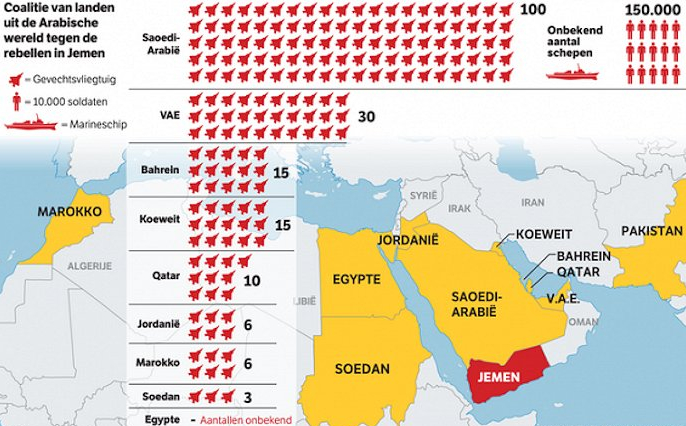
Sinds 26 maart voert Saoedi-Arabië, geruggensteund door een coalitie van Arabische landen (Marokko, Egypte, Soedan, Jordanië, Koeweit, Bahrein, Qatar en de Verenigde Arabische Emiraten) bombardementen uit op stellingen van Houthi-rebellen in Jemen. Daar werd na een opstand in 2011 president Ali Abdullah Saleh verjaagd om plaats te maken voor een president die eind maart op zijn beurt per boot vluchtte naar Saoedi-Arabië.

De Houthi-rebellen proberen sindsdien in grote delen van het land de macht te grijpen, tot groot ongenoegen van Saoedi-Arabië dat met negen bondgenoten nu al een maand lang stellingen van de Houthi-rebellen, die in hun strijd worden gesteund door soldaten die op hun beurt Ali Abdullah Saleh steunen,bombardeert. Volgens de VN zijn daarbij inmiddels meer dan 1000 mensen omgekomen, onder wie 551 burgers en minstens 115 kinderen. Voedsel en benzine worden steeds schaarser en prijzen stijgen daardoor explosief.

Het gevecht om Jemen staat symbool voor de strijd om de regionale macht tussen het sjiitische Iran en soennitische Saoedi-Arabië, maar er lijkt eerder sprake te zijn van eengeopolitiek conflict. De Saoedische koning Salman ziet in de opmars van de Houthi’s een aanwijzing dat Iran zijn invloed probeert uit te breiden in de regio. Daarnaast plegen de Jemenitische tak van al-Qaïda en de Islamitische Staat (IS) aanslagen op het Arabische Schiereiland (AQAS).

Europese wapens

VN-chef Ban Ki-moon riep half april tevergeefs alle strijdende partijen op om de wapens neer te leggen nadat eerder de VN-Veiligheidsraad het leveren van wapens aan de Houthi’s verbood. De coalitie tegen de Houthi’s wordt militair gesteund door deVS en strijdt met wapens gekocht van Europese landen. In hetEU-verslag over de wapenexport in 2013 was Saoedi-Arabië na de VS de belangrijkste klant voor Europese wapensystemen met een waarde van bijna 4 miljard euro. De VN stelde een wapenembargo tegen Jemen in en vroeg alle partijen de gevechten te stoppen, dat laatste overigens zonder succes.

Op 9 april werd bekend dat een vloot bestaande uit twee Iraanse schepen in internationale wateren richting Jemen voer. Het ging om de torpedobootjager Alborz en het ondersteuningsschip Bushehr. De schepen haalden internationaal de krantenkoppen. Wat daarbij niet werd vermeld, is dat de Alborz in 1969 werd gebouwd op de Britse scheepswerf Vickers en de Bushehr in 1974 op de West-Duitse scheepswerf C. Lühring waardoor beiden sterk verouderd zijn.


Onderwijl zet de coalitie onder aanvoering van Saoedi-Arabië eenbreed scala aan militaire vliegtuigen en marineschepen in. Jane’s Defence Weekly meldt dat de bijdragen van de betrokken tien landen ‘onduidelijk’ zijn. Het militaire tijdschrift verklaarde echter wel dat landen als Jordanië vliegtuigen inzetten en dat er volgens foto’s tevens sprake is van Egyptische, Jordaanse en Bahreinse F-16’s.

Jordanië kocht recent achttien F-16’s van Nederland en negen van België, tezamen ruim een derde van hun totale squadron. Als gevolg van het gevoerde compensatiebeleid door de Nederlandse overheid gedurende de afgelopen decennia, waarbij ons land als tegenprestatie voor de aankoop van Amerikaanse F-16’s onderdelen voor de productie van dit gevechtsvliegtuig mocht leveren, zijn ook de overige F-16’s van Jordanië met Nederlandse technologie uitgerust.

De Eurofighters (EFA/Typhoon) die gebruikt worden door de Saoedi’s, zijn een product van BAe Systems, Finmeccanica, en Airbus. Het laatst genoemde bedrijf is om fiscale redenen gevestigd in Nederland. Van de inzet van Eurofighters in de strijd met de Houthi’s werd melding gemaakt in de Britse media. Marine-raketsystemen worden hierbij eveneens ingezet waarvan verschillende typen (zoals Sea Sparrow, Harpoon) Nederlandse technologische onderdelen bevatten.  

Thales Nederland

Met een blik op de geografische kaart blijkt dat de Jemenitische kust bijna net zo lang is als de landgrenzen. De stranden langs de Golf van Aden en de smalle ingang aan de Rode Zee vormen de route naar de Middellandse Zee die via het Suezkanaal loopt. Geen wonder dat vanwege het door de VN ingestelde wapenembargo de coalitie marineschepen inzet buiten de territoriale wateren van Jemen voor de controle van schepen.

Naast Saoedi-Arabië is het vooral vazal Egypte dat betrokken is bij de zeeblokkade. Een bedankje aan de Saoedi’s vanwege de gulle donaties van het Huis van Saud aan president al-Sisis en zijn regering, in maart nog4 miljard dollar. Caïro heeft ook een eigen reden. Het gebruik van het Suezkanaal levert Egypte ongeveer 5 miljard dollar per jaar op. Het is daarmee een onmisbare bron voor harde valuta voor een land dat door de afname van het toerisme en de buitenlandse investeringen financieel vrijwel aan de grond zit.
54
Vuurleidingsradar van Thales Nederland

Verwacht wordt dat ook Pakistan zal toetreden tot de vloot voor deze zeeblokkade. De nieuwste Pakistaanse marineschepen worden gebouwd door China en zijn voorzien van Nederlandse militaire communicatie- en gevechtssystemen. De Pakistaanse Oliver Perry klasse is uitgerust met een derivaat geproduceerd door Thales Nederland, genaamd de Perry Mk 92 vuurleidingsradar (Signaal WM 28).

Begin april doken er berichten op dat de Egyptische marine raketten afvuurde op Jemen. De gebruikte wapens zijn voornamelijk afkomstig uit de VS, Zweden, Italië en Rusland. De radar, gevechtssystemen en onderdelen van de raketten is echter ten dele geproduceerd in Nederland. Jane’s Defence Weekly meldt dat het fregat Alexandrië (voorheen de Mubarak) is uitgerust met Mk 92 vuurleidingsradar en dat de snelle raketaanvalsschepen Ezzat Awent zijn uitgerust met Thales Nederland Scout dataverwerking.

Tijdens een parlementaire hoorzitting over het Nederlandse wapenexportbeleid op 13 april hield Thales zich van de domme en stelde niet te begrijpen waarom de regering aarzelde met het verlenen van toestemming voor de uitvoer van Thales producten voor de bouw van Egyptische marineschepen. Vuurleidingsradar is een essentieel onderdeel van een wapensysteem, evenals dataverwerkings- en gevechtssystemen. Momenteel werkt Egypte aan de bouw van Egyptes Gowindkorvetten. Thales levert hiervoor niet alleen de oppervlakte rondzoekradar, maar ook de doelaanwijsradar die cruciaal is voor moderne oorlogsvoering.

Geschreven voor Ravage-webzine

In English for Stop Wapenhandel 

dinsdag 28 april 2015

Dutch technology for major weapons in the Yemen war


A coalition of 10 countries, including the Gulf Cooperation Council (GCC), is  fighting in Yemen against Houthi rebels who forced Yemen's government into exile. Dutch weapon systems are playing an invisible but important role in this war; many of the participating navy ships are fitted with Thales Nederland fire control radar. Analysts say the war is not about Yemen's internal situation, but a proxy war between Saudi Arabia and Iran. They warn that the only winner will be terrorist groups like al-Qaeda in the Arabian Peninsula.


The Yemenites are confronted with destruction of their cities, infrastructure, and the scarce industrial facilities. Not to mention their deads, by heavy aerial and naval bombardments on cities. The US had to ask the Saudi's to narrow the scope of attacks.

The coalition against the Houthi's is actively sponsored though by US arms deliverances and fights with weapons sold by European countries as well (in the EU consolidated report on arms export 2013 Saudi Arabia was the second most important customer for EU-weapons, only after the US, with almost € 4 billion in one year). The United Nations installed an arms embargo against Yemen and - unsuccessfully - called to stop the fighting.

When Iran sailed to Yemen with two naval vessels, the destroyer Alborz and the axillary vessel Bushehr, it made headlines in the papers. What was not mentioned was that the Alborz is built at the British Vickers wharf as far back as 1969. The ship is one of a class of five (two others are more recently built in Iran). The Bushehr is build in 1974 at the C. Luhring, Brake wharf in Germany. Sold at their time to the Shah, for the most part of their lives the ships have belonged to the Islamic Republic. In response to the deployment of the oldies the US has send the aircraft carrier Theodore Roosevelt and the cruiser USS Normandy to the Gulf.

The Gulf Cooperation Council coalition and their friends are deploying a wide array of war planes and naval vessels (see illustration Business Insider). Jane's Defence Weekly of April 15, 2015 reported that the assets contributed by the countries involved 'remain vague'. The military magazine stated however that countries like Jordan are deploying jets and mentioned photo footage of Egyptian, Jordan and Bahraini F-16's taking part in the war. The kingdom of Jordan got 18 F-16's from the Netherlands and 9 from Belgium. Thus over a third of its 79 F-16 air frames came from the Benelux.


Due to offset policies of the past decades even the other F-16's used by the coalition are equipped with Dutch technology. The Eurofighters (EFA/Typhoon), which the Saudi's use in the operations, are a product of BAe Systems, Finmeccanica, and Airbus, the last company based in the Netherlands for tax reasons. The use of these planes was reported by UK media. Naval missile systems used (like Sea Sparrow, Harpoon) might also have Dutch components.

The map of the region shows that Yemen’s shoreline is almost as long as its land borders. Its beaches along the Gulf of Aden and the narrow entrance to the Red Sea are the route to the Mediterranean through the Suez canal. No wonder naval vessels have been deployed and used by the coalition in the Yemenite waters. It is also expected that Pakistan will join the fleet to enforce the naval blockade, but mission creep is already feared. It may be a method to circumvent the Pakistan Parliamentary opposition to join the forces against Yemen. The newest surface naval vessels of Pakistan were built by the Peoples Republic of China and fitted with Dutch military communication and combat data systems. Its Oliver Perry class is fitted with a Thales Netherlands derivative, the Perry Mk 92 fire control radar (Signaal WM28).

Above all, it is Egypt which is involved in the operations against the Houthi's. It owes this to the Saudi's, because of the generous donations made to al-Sisis by the House of Saud – the most recent donation of March 2015 worth 4 billion. Cairo has also its own reasons; the Suez Canal earns Egypt about $5 billion a year, a vital source of hard currency for a country that has suffered a slump in tourism and foreign investment. It is no surprise that the country has sent its navy to Yemen.

In early April reports turned up that the Egyptian navy fired missiles on Yemen. Of this navy, the guns come mainly from the US, Sweden and Italy and the radar, combat systems, and parts of missiles are also produced in the Netherlands. Jane's mentions the frigate Alexandria (formerly the Mubarak) fitted with Mk92 fire control radar and the fast attack misille craft Ezzat Awent fitted with Thales Nederland Scout data processing. At a Parliamentary round table on arms export however Thales Netherlands pretended not to understand why the Dutch government hesitated with giving permission for the export of Thales products to the wharf building Egypt’s naval vessels. While these are clearly and essential parts of the weaponsystems

Currently, work begins on Egypts Gowind corvette. Thales Netherlands will not only deliver its surface search radar, but also a crucial element of its direct fighting capabilities the target designation radar.

Written for: Stop Wapenhandel 
In Dutch

dinsdag 21 april 2015

US Defense Contracts with Dutch participation (08/07/14-20/04/15)

Products bought by the Dutch state and with Dutch participation (work will be performed by).

No: 518-13, July 17, 2013 , NAVY,
Raytheon Missile Systems, Tucson, Ariz., is being awarded a $19,070,236 modification to previously awarded contract (N00024-13-C-5403) for Standard Missile engineering and technical services for the U.S. Navy, other government agencies and foreign military sales.  This contract will provide engineering and technical services for Standard Missile 2, 3 and 6.  These services include research and development efforts; design, systems, and production engineering; technical services; evaluation services; component improvement services; and production proofing services for missile producibility, missile production, and shipboard integration for fiscal years 2013-2017.  This contract includes foreign military sales to Japan (28 percent), Australia (24 percent), Korea (21.5 percent), Germany (8.3 percent), Netherlands (8.3 percent), Taiwan (7 percent), Canada (1.7 percent), and Spain (1.2 percent).  Work will be performed in Tucson, Ariz. (86.8 percent); Andover, Mass. (9.4 percent); Huntsville, Ala. (1.7 percent); Arlington, Va. (1.1 percent); Camden, Ark. (0.7 percent); and White Sands, N.M. (0.3 percent), and is expected to be completed by July 2014.  Fiscal 2013 research, development, test & evaluation, Department of Defense, foreign military sales, fiscal 2013 research, development, test & evaluation, Navy, fiscal 2012 other procurement, Navy funding in the amount of $18,474,253 will be obligated at the time of the award.  Contract funds will not expire at the end of the current fiscal year. The Naval Sea Systems Command, Washington, D.C., is the contracting activity. 

No: CR-148-14, August 05, 2014, NAVY,
Raytheon Missile Systems, Tucson, Arizona, is being awarded a $43,991,627 modification to a previously awarded cost-plus-fixed-fee contract (N00019-12-C-2002) for the design, development, and engineering analysis of the AIM-9X Block II Missile System for the U.S. Navy, U.S. Air Force, and the governments of Turkey, Oman, Belgium, Netherlands, Singapore, Malaysia, and Morocco. This modification includes the necessary replacements for the AIM-9X Control Actuation System, inertial measurement unit, electronics unit processor and improvements in insensitive munitions performance in the hardware development and Operational Flight Software versions 9.4X, 9.15X and 10.X. Work will be performed in Tucson, Arizona (91.6 percent); Minneapolis, Minnesota (6.5 percent); Pinellas Park, Florida (1.3 percent); and Andover, Massachusetts (0.6 percent), and is expected to be completed in July 2015. Fiscal 2014 research, development, test and evaluation (Navy and Air Force) funds and Foreign Military Sales funds in the amount of $22,092,354, will be obligated at time of award, none of which will expire at the end of the current fiscal year. This contract combines purchases for the U.S. Air Force ($23,620,000; 53.7 percent); U.S. Navy ($8,155,233; 18.5 percent); and the governments of Turkey ($4,095,000; 9.3 percent); Oman ($2,590,000; 5.9 percent); Belgium ($2,100,000; 4.8 percent); Netherlands ($1,680,000; 3.8 percent); Singapore ($980,000; 2.2 percent); Malaysia ($701,394; 1.6 percent); and Morocco ($70,000; 0.2 percent) under the Foreign Military Sales Act. The Naval Air Systems Command, Patuxent River, Maryland, is the contracting activity.

No: CR-156-14 August 15, 2014, ARMY,
Raytheon Integrated Defense Systems, Andover, Massachusetts was awarded a $109,078,477 firm-fixed-price level-of-effort foreign military sales (Germany, Greece, Israel, Japan, Saudi Arabia, Korea, Kuwait, Netherlands, Spain, Taiwan, Ukraine) contract with options for engineering services for the Patriot System Tracking Radar. Work will be performed in Andover, Tewksbury, and Burlington, Massachusetts; El Segundo, California; El Paso, Texas; Huntsville, Alabama; Pelham, New Hampshire; and White Sands, New Mexico, with an estimated completion date of Jan. 31, 2015. One bid was solicited and one received. Fiscal 2014 operations and maintenance (Army) funds ($58,886), fiscal 2014 research, development, test, and evaluation funds ($5,287,374), and fiscal 2014 and 2010 other procurement funds ($76,462,599) are being obligated at the time of the award. Army Contracting Command, Redstone Arsenal, Alabama, is the contracting activity (W31P4Q-14-C-0093).

No: CR-227-14 November 26, 2014, NAVY, 
http://www.defense.gov/Contracts/Contract.aspx?ContractID=5426
Lockheed Martin Corp., Lockheed Martin Aeronautics Co., Fort Worth, Texas, is being awarded a $64,283,943 cost-plus-incentive-fee contract for the modification of 14 F-35A air vehicles for the U.S. Air Force (13) and the government of the Netherlands (1), and 13 F-35B air vehicles for the U.S. Marine Corps (11) and the government of the United Kingdom (2). This contract includes procurement for 528 modification kits, installation, and labor. Work will be performed in Fort Worth, Texas (40 percent); Cherry Point, North Carolina (12 percent); San Diego, California (10 percent); Cedar Rapids, Iowa (7 percent); Ogden, Utah (6 percent); Nashua, New Hampshire (4 percent); Eglin, Florida (3 percent); Greenville, South Carolina (3 percent); Samlesbury, United Kingdom (3 percent); Edwards, California (2 percent); Marabar, Florida (2 percent); Tucson, Arizona (2 percent); Redondo Beach, California (2 percent); Orlando, Florida (2 percent); Baltimore, Maryland (1 percent); and Owego, New York (1 percent), and is expected to be completed in September 2017. Fiscal 2013 aircraft procurement (Marine Corps and Air Force); 2015 research, development, test and evaluation (Marine Corps and Air Force), and international partner funds in the amount of $64,283,943 are being obligated on this award, $40,817,604 of which will expire at the end of the current fiscal year. This modification combines purchases for the U.S. Marine Corps ($30,784,983; 48 percent); U.S. Air Force ($25,077,651; 39 percent), and international partners ($8,421,309; 13 percent). This contract was not competitively procured pursuant to 10 U.S.C. 2304(c)(1). The Naval Air Systems Command, Patuxent River, Maryland, is the contracting authority (N00019-15-C-0016).

No: CR-243-14, December 19, 2014, NAVY, 
http://www.defense.gov/contracts/contract.aspx?contractid=5442
The Boeing Co., St. Louis, Missouri, is being awarded $8,644,374 for firm-fixed-price delivery order 2067 against a previously issued Basic Ordering Agreement (N00019-11-G-0001) for follow-on integrated logistics support/engineering services for Harpoon /SLAM-ER Missile System and Harpoon Launch Systems for the U.S. Navy and various foreign military sales customers. Work will be performed in St. Charles, Missouri (91.84 percent); St. Louis, Missouri (5.47 percent); Yorktown, Virginia (2.64 percent); and Oklahoma City, Oklahoma (.05 percent), and is expected to be completed in January 2016. Fiscal 2015 operations and maintenance (Navy) and foreign military sales funds in the amount of $8,644,374 will be obligated at time of award; $2,310,523 of which expire at the end of the current fiscal year. This contract combines purchases for the U.S. Navy ($2,310,523; 26.74 percent); and the governments of Turkey ($807,597; 9.35 percent); Taiwan ($706,776; 8.17 percent); Korea ($528,318; 6.11 percent); Japan ($471,056; 5.45 percent); Egypt ($456,647; 5.28 percent); Saudi Arabia ($365,656; 4.23 percent); United Kingdom ($316,563; 3.66 percent); Pakistan ($304,113; 3.52 percent); Australia ($303,525; 3.51 percent); Chile ($237,601; 2.75 percent); Canada ($231,071; 2.67 percent); Singapore ($216,855; 2.51 percent); Israel ($197,868; 2.29 percent); Portugal ($189,145; 2.19 percent); India ($168,656; 1.95 percent); Thailand ($165,516; 1.91 percent); Bahrain ($129,570; 1.50 percent); Kuwait ($88,155; 1.02 percent); United Arab Emirates ($85,015; 0.98 percent); Malaysia ($84,819; 0.98 percent); Oman ($83,837; 0.97 percent); the Netherlands ($81,455; 0.94 percent); Germany ($65,164; 0.75 percent); and Denmark ($48,873; 0.57 percent) under the foreign military sales program. The Naval Air Systems Command, Patuxent River, Maryland, is the contracting activity.

No: CR-245-14, December 23, 2014, NAVY
Raytheon Co., Tucson, Arizona, is being awarded a $49,000,000 modification to previously awarded contract (N00024-13-C-5410) to exercise options for the accomplishment of Evolved SeaSparrow Missile (ESSM) design agent, in-service support and technical engineering support services.  The ESSM program is an international cooperative effort to design, develop, test, and procure ESSM missiles and related support and services. The ESSM provides enhanced ship defense.  Work will be performed in Tucson, Arizona (90.65 percent); Germany (2.55 percent); Norway (2.11 percent); Australia (1.53 percent); Netherlands (1.36 percent); Canada (0.68 percent); Spain (0.42 percent); Turkey (0.30 percent); Denmark (0.28 percent); and Greece (0.12 percent) and is expected to be completed by December 2015.  Fiscal 2015 weapons procurement (Navy); fiscal 2015 research, development, test and evaluation; and fiscal 2015 operations and maintenance (Navy) funding in the amount of $14,439,376 will be obligated at time of award and funds in the amount of $1,953,715 will expire at the end of the current fiscal year. The Naval Sea Systems Command, Washington, District of Columbia, is the contracting activity.

No: CR-248-14, December 30, 2014, AIR FORCE, 
http://www.defense.gov/Contracts/Contract.aspx?ContractID=5448
Boeing Aerospace Operations Inc., Oklahoma City, Oklahoma, has been awarded an estimated $18,681,615 firm-fixed-price and time and materials modification (P00203) to contract FA8106-07-C-0001. Contractor will provide engineering services support including sustaining and non-recurring engineering services for Boeing commercial derivative military aircraft. Work will be performed at Oklahoma City, Oklahoma, and is expected to be completed by Dec. 31, 2015. This contract has a small portion of foreign military sales to the Netherlands. Fiscal 2015 operations and maintenance funds in the amount of $10,209,260 are being obligated at the time of award. Air Force Life Cycle Management Center, Tinker Air Force Base, Oklahoma, is the contracting activity.

No: CR-024-15, February 05, 2015, NAVY,
Raytheon Missile Systems, Tucson, Arizona, is being awarded a $9,603,500 modification to previously awarded contract (N00024 13 C-5403) for Standard Missile 2 (SM-2) and Standard Missile 6 (SM-6) engineering and technical services.  This contract will provide for engineering and technical services in support of SM-2 and SM-6 to ensure continuity in production, design integrity and total systems integration of the missile round and its components.  This contract combines purchases for the U.S. Navy (23 percent) and the governments of Japan (50.2 percent), Taiwan (14.8 percent), the Netherlands (4.3 percent), Korea (4.2 percent), Germany (2.9 percent) and Spain (.6 percent) under the Foreign Military Sales (FMS) program or cooperative agreements.  Work will be performed in Tucson, Arizona, and is expected to be completed by December 2015.  FMS, fiscal 2015 research, development, test and evaluation, fiscal 2014 weapons procurement (Navy) and Cooperative Agreements funding in the amount of $9,603,500 will be obligated at time of award and will not expire at the end of the current fiscal year.  The Naval Sea Systems Command, Washington, District of Columbia, is the contracting activity.

No: CR-051-15, March 19, 2015, ARMY,
Intuitive Research and Technology Corp.,* Huntsville, Alabama, was awarded a $14,128,559 modification (000382) to Foreign Military Sales contract W31P4Q-07-A-0015 (Egypt, Korea, Chile, Finland, Netherlands, Oman, Qatar, United Kingdom, Norway) for labor and travel to support the Cruise Missile Defense Systems Project Office. Fiscal 2015 research, development, testing and evaluation, operations and maintenance (Army) and other procurement funds in the amount of $ $14,128,559 were obligated at the time of the award. Estimated completion date is Nov. 23, 2015. Work will be performed in Huntsville, Alabama. Army Contracting Command, Redstone Arsenal, Alabama, is the contracting activity.

No: CR-061-15, April 02, 2015, NAVY,
Raytheon Missile Systems, Tucson, Arizona, is being awarded a $517,300,000 cost-plus-incentive-fee and cost-plus-fixed-fee contract for the Evolved Seasparrow Missile (ESSM) Block 2 engineering and manufacturing development (EMD) requirements. This contract will procure all necessary efforts to design, qualify and test ESSM Block 2 and prepare the program for a successful ‘Milestone C’ decision, currently planned in FY18. The ESSM Block 2 is an international cooperative effort to design, develop, test, and procure ESSM Block 2 missiles. ESSM Block 2 provides enhanced ship self-defense. This contract combines purchases for the Navy (40 percent) and the governments of Australia (16.51 percent), Canada (13.77 percent), Germany (6.44 percent), the Netherlands (5 percent), Denmark (4.56 percent), Norway (4.56 percent), Turkey (4.56 percent), Spain (2.5 percent), Greece (1.5 percent), and Portugal (.6 percent), as part of the NATO Seasparrow Consortium. Work will be performed in Tucson, Arizona (67 percent); Norway (2 percent); McKinney, Texas (5 percent); Australia (3 percent); the Netherlands (3 percent); Canada (3 percent); Germany (3 percent); Turkey (2 percent); Andover, Massachusetts (2 percent); San Marco, California (1 percent); San Diego, California (1 percent); San Jose, California (1 percent); Cincinnati, Ohio (1 percent); Canton, New York (1 percent); Greece (1 percent); Denmark (1 percent); and with 3 percent in various locations that each will perform less than 1 percent of the effort, and is expected to be completed by May 2019. Fiscal 2015 research, development, test and evaluation funs and foreign Military Sales contract funds in the amount of $26,000,000 will be obligated at time of award and will not expire at the end of the current fiscal year. This contract was not competitively procured. Full and open competition need not be provided for when precluded by the terms of an international agreement or a treaty between the U.S. and a foreign government or international organization, or the written directions of a foreign government reimbursing the agency for the cost of the acquisition of the supplies or services for such government. The Naval Sea Systems Command, Washington, District of Columbia, is the contracting activity (N00024-15-C-5420).